
The Capital Runs on Widener Law Grads. Mark Kovalcin '17 Is Living Proof
Mark Kovalcin '17
Image
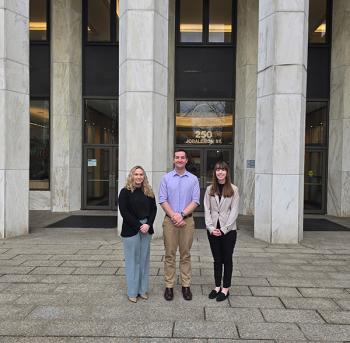
Mark Kovalcin '17 found his footing in government law the same way a lot of Widener University Commonwealth Law School graduates do: through a connection that became a mentor, a mentor that helped shape a career, and a career that eventually brought him back to help the next generation of students.
That cycle of alumni investing in students is one Kovalcin knows from both sides.
Today, he serves as assistant counsel at the Pennsylvania Health Insurance Exchange Authority, known as Pennie. He also chairs the board of the Widener Law Commonwealth Alumni Association, coaches moot court and trial advocacy teams, and teaches administrative litigation as an adjunct professor. The same alumni network that helped launch his career is now one to which he actively contributes.
“I keep tripping over Widener graduates whenever I go into government meetings,” Kovalcin said. “There are so many of us out there who are eager and willing to help students advance their careers.”
That presence throughout the Pennsylvania government is part of what drew him to Widener Law Commonwealth. Harrisburg offered proximity to the courts, agencies and state offices where public sector legal work happens every day.
For Kovalcin, the location mattered.
A native of the State College area, he studied finance and marketing at the University of Pittsburgh at Johnstown and graduated into the uncertainty of the 2008 financial crisis. He briefly worked as a personal financial planner before moving to Pittsburgh to become a telephone stockbroker for PNC. Over time, he realized he was less interested in sales and more drawn to the regulations and compliance work happening behind the scenes.
A friend who had recently graduated from law school encouraged him to consider the legal profession. The idea stuck. When Kovalcin started looking at law schools, Widener Law Commonwealth stood out because it placed him close to the center of Pennsylvania government and regulatory work.
Once he arrived on campus, he immersed himself in nearly everything he could.
He joined Law Review, Moot Court Honor Society, and Trial Advocacy Honor Society, served on executive boards, traveled to advocacy competitions, and earned a second overall oralist award during his second year. He also worked as a research assistant and academic success fellow.
“I wanted to make myself look as attractive on paper as possible,” Kovalcin said. “I understood the resume is what gets you in the door.”
Still, the experiences that stayed with him most came from the people teaching inside the classrooms and coaching outside them.
Associate Dean Anna Hemingway helped shape how he approached legal research and writing. Professor Jim Diehm took a subject Kovalcin thought he had no interest in and turned it into one of his favorite classes because of the energy he brought into the room. Professor Michael Dimino impressed him with a command of constitutional and administrative law that seemed effortless.
“He could stand there and talk for 30 minutes about a case with no notes and give you insights far beyond the opinion itself,” Kovalcin said. “It was just unbelievable.”
Then there was Jon Koltash '07.
Koltash coached Kovalcin’s Moot Court team and became one of the most influential mentors in his life and career. Years later, the two would work together at the Pennsylvania Department of Health before reconnecting again at Pennie.
“Not just a friend,” Kovalcin said, “but a long-term mentor.”
After graduating, Kovalcin clerked for then-Judge Kevin Brobson '95, now a justice on the Pennsylvania Supreme Court. The role exposed him to a broad range of legal issues and helped solidify his interest in government service.
He later joined the Pennsylvania Department of Health just as the Commonwealth launched its Office of Medical Marijuana. Not long after, the COVID-19 pandemic reshaped nearly every aspect of public health law and government operations.
“I didn’t know one agency could get sued so many times,” he said with a laugh.
The work demanded flexibility and forced him to quickly adapt to rapidly changing legal issues. It also gave him a clearer picture of the kind of career he wanted.
At Pennie, no two days look alike. He may handle litigation in the morning, contract review in the afternoon and HR or administrative issues before the day is over.
“I come in with a list of things I want to accomplish, and usually by this point in the day, that list is completely different,” Kovalcin said. “Every day is going to be different. That’s what keeps me coming back.”
For prospective students interested in government or regulatory law, Kovalcin said the biggest advantage Widener Law Commonwealth offers is access to people already working in those spaces.
As a first-generation attorney, he understands how intimidating the legal profession can feel when you are trying to navigate it without built-in connections. He still remembers a professor connecting him with an attorney over coffee simply so he could learn more about a specific area of law. That conversation helped him narrow his own career interests, and it shaped how he approaches mentorship today.
“When you’re in law school, you don’t always realize how important networking is,” Kovalcin said. “If we can help connect students with people already doing the work they’re interested in, that can completely change the trajectory of somebody’s career.”
Kovalcin also encourages students and young attorneys to stay teachable and to be honest when mistakes happen.
“There’s almost no mistake that can’t be fixed,” he said. “But I can’t help fix it if nobody tells me.”
Outside of work, Kovalcin said it is important for law students and attorneys to protect hobbies and interests beyond the profession itself.
“It’s nice to take off the lawyer hat for a while,” he said. “Having something outside of the law really matters.”
Interview conducted in Summer 2026.


