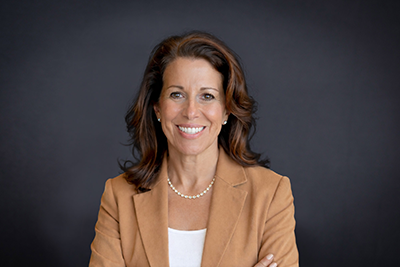
Christie Corado ’93 has spent decades advising companies through high-stakes decisions, from mergers and acquisitions to compliance, privacy and risk. But in recent years, even for a seasoned corporate lawyer, something changed.
Artificial intelligence stopped being a distant conversation and became part of the work itself.
For Corado, a Widener University Commonwealth Law School alumna who now serves as general counsel, corporate secretary and chief privacy officer at MIB Group Holdings, that shift happened in real time. She joined the data and technology company in 2021 just as AI regulation in the insurance industry began to accelerate, placing her at the center of fast-moving questions about governance, risk and responsible use.
Since then, she has built a reputation as a clear, practical voice on what AI means for lawyers, especially in highly regulated industries such as insurance, where bias, privacy and compliance carry real consequences.
Now, in an era when many lawyers are still debating whether AI belongs in legal practice at all, Corado approaches the question from a different angle: how lawyers can integrate AI responsibly without surrendering judgment, accountability or public trust, and she’s bringing that perspective back to Widener Law Commonwealth.
“This change isn’t coming – it is already here,” Corado said. “It’s either learn how to integrate AI responsibly or wake up to a profession that has moved on without you.”
Corado isn’t teaching AI as a futuristic concept. She teaches it as a present-day reality that is already reshaping how lawyers think, write and advise clients.
A 1993 graduate of Widener University School of Law, Corado began her legal career in a life insurance brokerage firm as an advanced marketing attorney, building on her interests in tax, estate planning, securities and corporate law. Over the next 28 years, she rose through corporate legal leadership roles, including serving as general counsel of Crump Life Insurance Services and later as senior vice president and deputy general counsel at Truist Insurance Holdings.
Her move to MIB Group in 2021 marked a turning point.
MIB provides integrated data and digital solutions to 350 life insurers across the United States and Canada, enabling clients to reduce fraud, streamline underwriting, ensure compliance and enhance portfolio analytics. That work places Corado at the intersection of data, technology and regulation. As AI-related laws began emerging, she found herself working with insurance regulators through complex questions about how companies can adopt these tools responsibly.
That work led her deeper into issues of corporate governance and bias, particularly how algorithmic tools can unintentionally produce unfair outcomes based on data tied to race, gender, ZIP code or other sensitive factors.
Through her industry-facing regulatory work on emerging AI and data governance frameworks, Corado has a front-row view into how regulators are thinking about AI risk, accountability and enforcement in real time.
“The early AI conversation focused on bias because it had to. When algorithms affect real people, governance isn’t optional—it’s a legal and ethical obligation.” Corado said. “These concerns are particularly acute in regulated contexts where automated tools may influence underwriting, claims decisions or fraud investigations. My role as a corporate lawyer is to anticipate where harm could occur and make sure the guardrails are in place before problems surface. That perspective has proven especially valuable for students.
At Widener Law Commonwealth, Corado has helped students engage with AI in practical ways. After first returning to campus as a guest speaker, she began teaching in summer 2024 and later led a two-credit course on AI and the law in the fall of 2025. Drawing on her regulatory expertise and professional network, she helps students understand not just what the law says but how the regulatory expectations take shape before they appear in formal laws. Corado has brought in industry experts to speak on privacy, data security, ethics and regulation, helping students understand how widely AI is already shaping legal practice.
Because, as she makes clear, this isn’t limited to one area of law.
AI is showing up in corporate transactions, contract review, litigation strategy, compliance, intellectual property, and more. It’s changing not whether lawyers are needed, but how they work.
“It’s not scarcity,” Corado said. “Nobody should be thinking we don’t need lawyers anymore. What’s changing is the focus of the profession and especially of the entry-level lawyer.”
For years, young attorneys built experience through time-intensive work like document review and drafting. AI can now handle much of that more efficiently. But instead of eliminating jobs, Corado said, it raises expectations.
New lawyers will be expected to analyze, verify and exercise judgment earlier in their careers. They’ll need to understand what a strong contract looks like, where risk lives, and when an AI-generated answer falls short. That’s a higher bar, not a lower one.
“There needs to be a human in the loop – because accountability cannot be automated. AI may assist the work, but responsibility still sits squarely with the lawyer,” she said.
That message resonates with students, many of whom are still figuring out how to approach AI. Some are curious. Others are cautious. A few are uneasy about what it might mean for their careers.
Corado understands the concern, but she doesn’t share the more pessimistic outlook.
In fact, she expects demand for lawyers to grow as organizations navigate the legal and compliance challenges tied to AI adoption.
“Companies are adopting AI quickly, often faster than the governance frameworks around it,” she said. “That gap is going to drive demand for lawyers who understand regulation, risk and accountability—not just the technology itself.”
That uncertainty, she said, will lead to increased work in governance, compliance, and litigation as companies sort through early decisions and their consequences.
“There’s going to be a need for higher-level thinkers,” she said, “who can connect technology, regulation, and real-world consequences. That skill set is going to be in constant demand and provide new opportunities.”
For Widener Law Commonwealth, that presents a clear opportunity as well.
Corado believes AI won’t remain confined to a single course. Over time, she expects it to be integrated across the curriculum, from contracts to legal writing to research, where students will learn not only the fundamentals of the law but how those fundamentals apply in an AI-assisted environment
“You still have to learn the fundamentals of the law,” she said. “But now you also need to understand how those fundamentals are applied in an AI-assisted legal environment.”
That approach reflects a broader effort at the law school to engage seriously with AI, focusing not just on what the technology can do, but on ethics, responsibility and the lawyer’s role in guiding its use.
For Corado, that balance is essential.
She’s quick to point out both the potential and the risks, from efficiency gains in drafting and due diligence to concerns about data security, bias and unreliable outputs. Professional responsibility, she emphasized, doesn’t change simply because new tools are involved.
Nor should the mindset.
One of the biggest challenges, she said, is moving past the instinct to treat AI as something to avoid or distrust entirely.
Instead, lawyers need to learn how to use it thoughtfully and responsibly.
“This is the future,” Corado said. “The future belongs to lawyers who are willing to engage, set the rules (when they do not exist) and take responsibility for how these tools are used.”
For students, hearing that from someone who has spent more than three decades in the profession carries weight.
Corado isn’t just teaching theory.
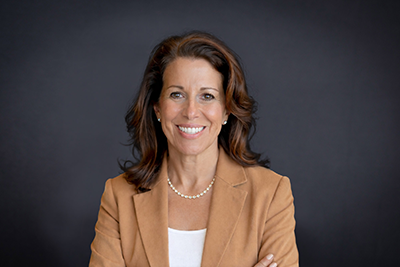
She’s helping them prepare for a profession in transition, one that will reward adaptability, sound judgment and a willingness to engage with change.
“I think the future’s bright,” she said. “And I think the future for Widener is bright as it leads the way for modern legal education.”