At Widener University Commonwealth Law School, a reimagined student-run podcast is taking shape as both a creative outlet and a strategic storytelling tool, one designed to capture the realities of law school while pulling in broader audiences through timely legal conversations and high-interest guests.
The project was built from the ground up by students in the entertainment law fellowship, who led every step of the process. Students are batching episodes, experimenting with format, and building a release rhythm that mirrors professional media production, with the goal of launching in the spring semester once a strong catalog is in place.
From the beginning, students wanted the podcast to feel real, not scripted or overly polished. The goal is simple: meet prospective students where they are, speak plainly about the law school experience, and pair that student perspective with conversations that connect the law to the world people are already paying attention to.
“I think people are always looking for an inside scoop,” said Owen R. Dougherty, a rising third-year student. “There weren’t many places where students were just talking honestly about what this is actually like.”
That instinct, to make law school more understandable and less intimidating, runs through every aspect of the podcast’s design. For Andrea Hernandez-Rodriguez, a rising three-year student and entertainment law fellow, that mission is personal.
“I’ve been translating complicated systems for people my entire life,” Hernandez-Rodriguez said. “This podcast is about taking really niche areas of law and turning them into conversations that are palatable and digestible, so people can meet us where they are and then move forward together.”
Rather than running a single show with one tone, the team built a structure that can serve different audiences while staying authentic.
The external-facing series, The Final Deposition, will feature longer, more produced conversations with alumni, faculty, and guests whose work intersects with law, policy, media and culture. Topics under consideration include true crime and criminal justice, emerging technology and artificial intelligence, Supreme Court and constitutional law developments, military and veterans’ law and leadership at major law firms.
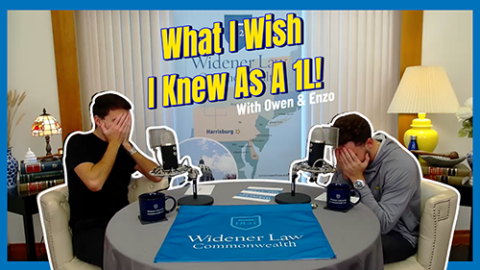
The internal series, Late Night in the Library, will focus on student-centered conversations recorded in shorter, 20- to 25-minute episodes. These episodes are designed to be candid and practical, covering topics like what students wish they knew before their first year, surviving cold calls, networking in law school, balancing work and evening classes and navigating mental health.
“For me, it’s a space where I don’t have to put my creative side away,” said Shemariel Gray, a second-year extended division student. “Law school can feel rigid. This gives us room to talk, to ask questions and to actually connect with people.”
Hernandez-Rodriguez echoed that sentiment, noting that law school can limit creative outlets in ways students do not always expect.
“If you’re looking for a way to blend creativity with the law, this does that,” she said. “You get to curate your own episode, choose topics you actually care about and have real conversations. That autonomy is rare, and it’s meaningful.”
Gray’s journey spans continents and careers. Originally from Belize and raised in southern California, she first explored civic engagement through youth and government programs before working as an advocate supervisor with the Court Appointed Special Advocate program, supporting children navigating the court system.
“I was in court watching decisions that changed kids’ lives,” she said. “That’s when I realized how much power there is in asking the right questions.”
Hernandez-Rodriguez, who was born in Mexico and came to the United States as a child, said her lived experience shapes how she approaches storytelling and interviews.
“A lot of people think there’s one immigrant story,” she said. “There isn’t. Being able to unpack those differences, and do it in a way that people can actually understand, is something I bring into the podcast.”
Enzo Fetsko, a rising third-year student from Connellsville, Pennsylvania, came to law school through a different route. A finance major at West Virginia University, he initially kept law school in the background until a hands-on experience at the Fayette County District Attorney’s Office and later as a legal assistant at a Widener alumni-owned firm.
“That really solidified it,” Fetsko said. “Seeing what lawyers actually do day to day made it real.”
Those different paths are part of the point. The podcast is designed to capture a range of perspectives, not just one “typical” law school story. Students say that range helps prospective students picture themselves here, whether they are coming straight from college, switching careers, commuting for evening classes or figuring things out as they go.
Dean andré douglas pond cummings said the podcast reflects Widener Law Commonwealth’s long-standing emphasis on student-driven learning.
“For decades, Widener Law Commonwealth has provided hands-on, experiential education that pushes students beyond the classroom,” cummings said. “This podcast is emblematic of that work. Students aren’t just learning about the law. They’re planning, producing, interviewing and delivering meaningful content that connects law to real industries and real people.”
Students also plan to supplement the podcast with short-form video content, including quick interviews between classes and social clips designed for platforms like Instagram, TikTok, YouTube Shorts and LinkedIn.
“If I’m not interested in the first few minutes, I’m probably not sticking around,” Fetsko said. “The clips are what make people curious.”
Behind the scenes, students are learning the less visible side of media production. Meetings have focused on batching episodes, avoiding overly time-sensitive references, navigating copyright and branding, and maintaining consistent release schedules.
“We spent an entire meeting just choosing the title and the music,” Hernandez-Rodriguez said. “It really is from the ground up. At first, that was daunting, but it also showed how much trust the school puts in us."
Students are expected to pitch episode ideas, take ownership of production, schedule guests and help shape interviews, with staff providing guidance and quality control. Each episode, Hernandez-Rodriguez said, feels personal.
“It’s like your baby,” she said. “You’re responsible for how it turns out, and that makes you care about it in a different way.”
As the team moves toward launch, recordings are already underway, with internal episodes being used to test production workflows before external interviews roll out. The goal is not speed, but quality.
“We’re not putting anything out until it’s ready,” Gray said. “But once it is, I think it’s going to feel very real.”
And that, students say, is exactly the point.
The podcast is officially launched on June 2, 2026. Tune in wherever you get your podcasts.