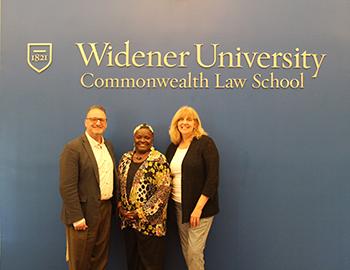
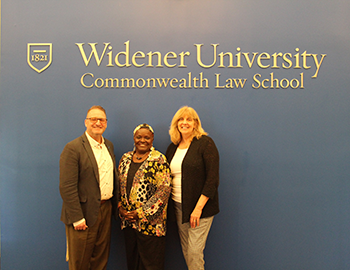
More than a decade after serving as dean of Widener University School of Law, Dean Emerita Linda Ammons returned to Widener Law Commonwealth this summer to teach during the law school’s intersession program.
Ammons, who served as dean from 2006 to 2014 when the Delaware and Harrisburg campuses operated as the unified Widener University School of Law, taught a four-day course on art and the law, introducing students to the wide-ranging legal issues connected to the art world.
“This was the first time since 2014 I’d had the opportunity to be on the Harrisburg Commonwealth campus,” Ammons said. “Needless to say, it was a nostalgic experience. My warm reception by Dean cummings and other staff members and faculty who had been there when I was dean was quite touching. I am happy to see that the school is doing so well.”
Dean andré douglas pond cummings and Anna Hemingway, associate dean for academic affairs, professor of law, and director of the Legal Methods Program, welcomed Ammons back to campus, including a visit to the Douglas M. Wolfberg Courtroom, where a portrait of Ammons with alumnus Patrick J. Murphy hangs prominently. Murphy ‘99, a former Widener trustee, went on to become a congressman and later served as under secretary of the Army.
“Back when the two law schools were unified as the Widener University School of Law and differentiated only by campus designation, Dean Ammons led both campuses with grace and distinction,” cummings said. “We were delighted to welcome her back to campus and have our students learn from her tremendous experience and expertise.”
For Ammons, the course also represented the intersection of two lifelong passions: art and the law.
“I have been an artist longer than I have been a lawyer,” Ammons said. “As a photographer, my early concerns were copyright. Over the years, my interest expanded because of my own art collections and learning that the two- and three-dimensional art industry in the United States is valued at more than $80 billion a year.”
Throughout the course, students explored topics including copyright infringement, taxation and tariffs on art, probate issues, cultural appropriation, stolen artwork from World War II and efforts to return it to rightful owners, the use of the Uniform Commercial Code in cases involving fake art sold to consumers, and emerging questions surrounding artificial intelligence and art authentication.
“There is a lot to cover in just four days,” Ammons said. “But at the end of the class, I was told by a student that I had opened a whole new world for her. That gave me great satisfaction because that is what education is all about.”
Ammons encouraged students to embrace opportunities outside the traditional law school curriculum and remain open to discovering unexpected interests.
“In addition to studying hard, take advantage of as many opportunities that come your way that you can manage while doing your very best,” she said. “Move beyond the required courses and explore a topic that could prove to be interesting and a lifelong passion. Don’t be afraid to experiment. The time in law school will pass very quickly.”