The future of business law may depend less on checking boxes and more on asking whether the system can be trusted.
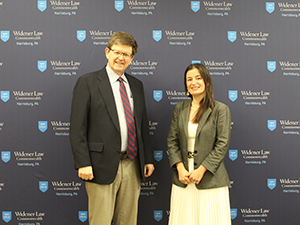
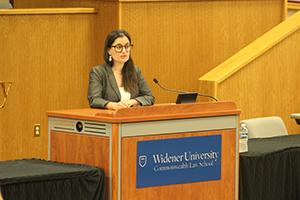
That was the central idea behind the fourth annual Justice Strong Lecture at Widener University Commonwealth Law School, where Miriam Goldby, a professor of shipping, insurance, and commercial law at Queen Mary University of London School of Law, spoke about how lawyers can help businesses navigate cyber risk, electronic commerce and rapidly changing technology.
Goldby, a Fulbright visiting scholar at the University of Texas, delivered the lecture on outcomes-based regulation and the business lawyer. The topic is complex, but its practical point is clear: in areas like cybersecurity and electronic transactions, the law cannot always keep pace by listing every step a business must take. Instead, some laws focus on the result that must be achieved.
For digital trade, that result is reliability.
Goldby explained that electronic documents and systems should not simply replace paper because they are faster or more convenient. They must be dependable enough for people, businesses and courts to trust them. A paper document has long carried legal weight because people understand how possession, signatures and records work. Electronic documents must meet the same level of confidence in a different format.
That matters in international commerce, where businesses increasingly rely on digital systems to move goods, manage financial transactions and verify who has control of valuable trade documents.
Professor Christian Johnson, who helped establish the Justice Strong Lecture series during his time as dean, said Goldby’s lecture gave students a window into the kind of judgment modern lawyers need.
“Professor Goldby showed our students that business lawyers are not just technicians who read statutes and contracts,” Johnson said. “They are counselors who have to understand risk, ask hard questions and help clients make decisions that are legally sound and ethically responsible.”
Goldby connected her remarks to Justice William Strong, a Pennsylvania lawyer and former U.S. Supreme Court justice for whom the lecture is named. Strong practiced law in Reading, Pennsylvania, served on the Pennsylvania Supreme Court and was later nominated to the U.S. Supreme Court by President Ulysses S. Grant. He was known for his work in commercial law and constitutional questions.
Goldby used Strong’s legacy to frame a larger point: good legal interpretation looks beyond the bare words of a rule and considers its purpose.
In cybersecurity, that approach has real consequences. A company may be able to show it followed a checklist, but that does not always mean its system is safe, reliable or prepared for emerging threats. Goldby argued that businesses and lawyers should stay focused on whether the goal of the law is being met.
Dean andré douglas pond cummings said the lecture reflects Widener Law Commonwealth’s commitment to preparing students for legal problems that do not come with easy answers.
“Our students will practice in a world where technology, commerce and regulation are changing at extraordinary speed,” cummings said. “The Justice Strong Lecture helps them see that lawyers must bring not only legal knowledge, but judgment, integrity and a clear sense of responsibility to the work.”
The annual lecture focuses on ethics and business law, bringing scholars and practitioners to campus to explore issues that shape the legal profession. This year’s program was held in the law school’s Douglas M. Wolfberg Courtroom.
Goldby’s lecture made that point through the lens of digital commerce, where trust is essential, and the stakes are growing. In a world built increasingly on electronic systems, lawyers will be asked to help decide not only whether something is permitted, but whether it is reliable enough to stand behind.