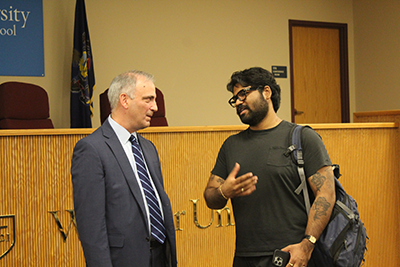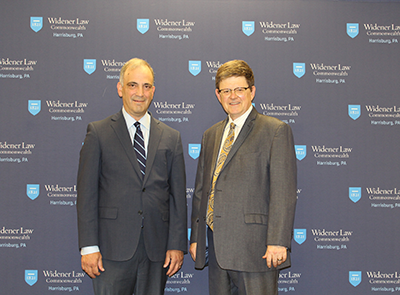
U.S. Court of Appeals Judge Joseph F. Bianco visited Widener University Commonwealth Law School recently for a talk that offered an inside look at the federal courts and judicial decision making. What began as a professional development event quickly turned into an interactive civics class that put students at the center of the story.
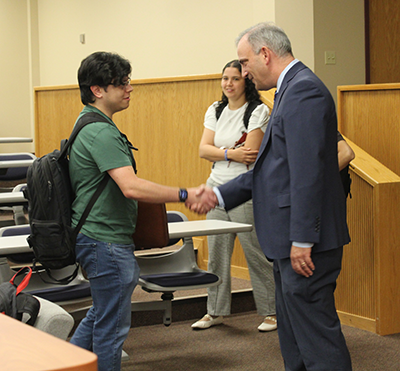
After laying out that journey, he shifted into an engaging round of questions for the audience. The first quiz focused on Tinker v. Des Moines, the Vietnam War armband case about student speech in schools. When first-year student Audrey Confer identified the case and explained its holding, Bianco surprised her with a special prize, an armband signed by Mary Beth Tinker herself.
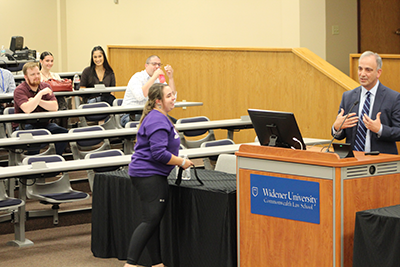
For her, the signed armband carried deep meaning. “In such a turbulent time of political uncertainty, it’s a beautiful symbol of the people who fought before you for the freedoms you have,” she said.
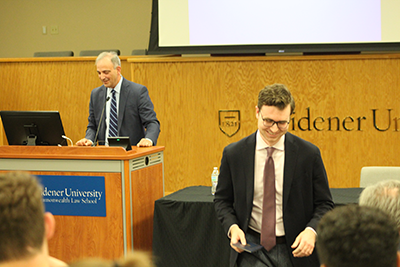
For Anderson, the moment carried a personal connection. “When Judge Bianco asked which president also served as a justice on the Supreme Court, it felt like the question was tailored for me,” he said. “It felt perfect answering in front of my classmates because they know how much I love U.S. history.”
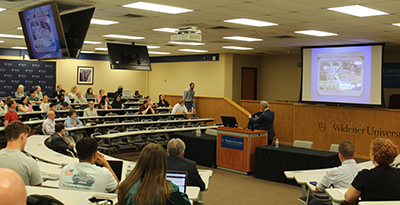
Dean andré douglas pond cummings welcomed Bianco by reminding students why face-to-face time with sitting judges matters. “It’s part of the fabric of a great law school to bring the bench to our community,” he said. “Judge Bianco sits one step below the U.S. Supreme Court, and hearing directly from someone who’s making decisions that shape our democracy is of critical importance.”
Professor Christian Johnson, who organized the program, said the night was designed to show both the craft of appellate judging and the unexpected ways legal careers can unfold.
Bianco walked students through cases involving free speech, search and seizure, and tribal sovereignty to show how judges approach complex questions. Between case studies, the giveaways and quizzes kept students leaning forward. “They didn’t just hear about precedent,” Johnson said. “They applied it in the room and saw how judges think through it.”
For Confer, the personal side of Bianco’s talk stood out just as much as the civics lesson. “As a Christian, I really appreciated his insight into combining faith with work,” she said. “It helped me to clearly see what kind of lawyer I want to be.”
Anderson echoed that reflection. “The ultimate reason for attending law school is to represent people who need assistance in a time of need,” he said. “One cannot properly assist someone going through perhaps the most difficult time in their life if they are cold and care only about writing an argument or receiving pay. Lawyers must also be there as a person who can empathize with their client.”