Salamasina “Sala” Fitisemanu once needed help seeing law school as a possibility. This fall, she helped welcome 45 prospective students who are considering that same path.
A second-year student at Widener University Commonwealth Law School, Fitisemanu helped organize the Pathway Program’s recent Day at the Law School as a Center for Equity and Justice fellow. For someone who entered the Pathway Program herself, unsure how to approach the law school admission test, it was a chance to help others find the guidance that had made a difference for her.
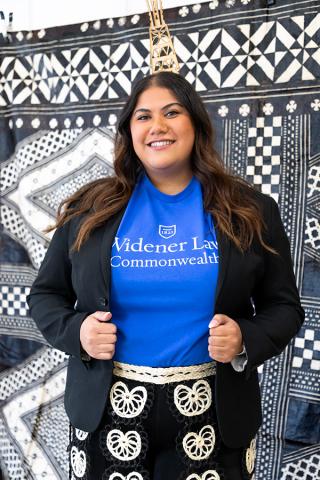
“Once I realized maybe I can do this, maybe this is attainable, everything just kind of started rolling from there,” Fitisemanu said.
The Center for Equity and Justice’s Pathway Program combines 12 weeks of free law school admissions test, or LSAT, instruction with opportunities to experience law school and meet the people who teach and study there. Funded through grants from the Boulé Foundation and the Law School Admission Council, it includes classroom visits and a Day at the Law School designed to give participants a closer look at legal education.
“Fundamentally, the Pathway Program is about providing access to a legal education to populations that have been previously and historically excluded and shut out,” Dean andré douglas pond cummings said.
Eight former participants in the Pathway and Plus programs entered Widener Law Commonwealth’s first-year class this fall, cummings said.
For the current Pathway cohort, selected through a competitive application process, the recent campus visit offered a chance to ask questions that extend beyond test scores and applications: How will law school fit into my life? What will be expected of me? Will I find my place?
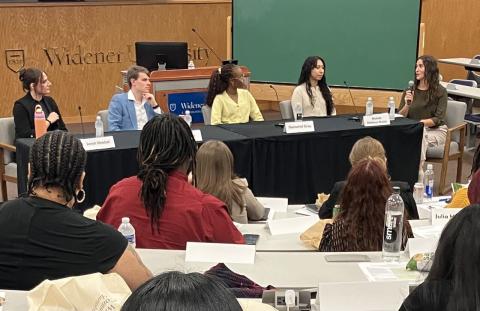
Fourth-year evening division student Isaac Evans recognized those concerns during the student panel, particularly when the conversation turned to choosing between part-time and full-time study.
Before enrolling, Evans had weighed how he would manage coursework alongside his job and other responsibilities. He worried about finding a balance, but he also hoped the experience would help him grow.
Now nearing the end of his legal education, he wanted participants to understand both the demands of law school and the support they could find along the way.
“I want participants and prospective students to understand law school is difficult, and you must work hard; however, that does not mean you won’t find good people who will support you,” Evans said.
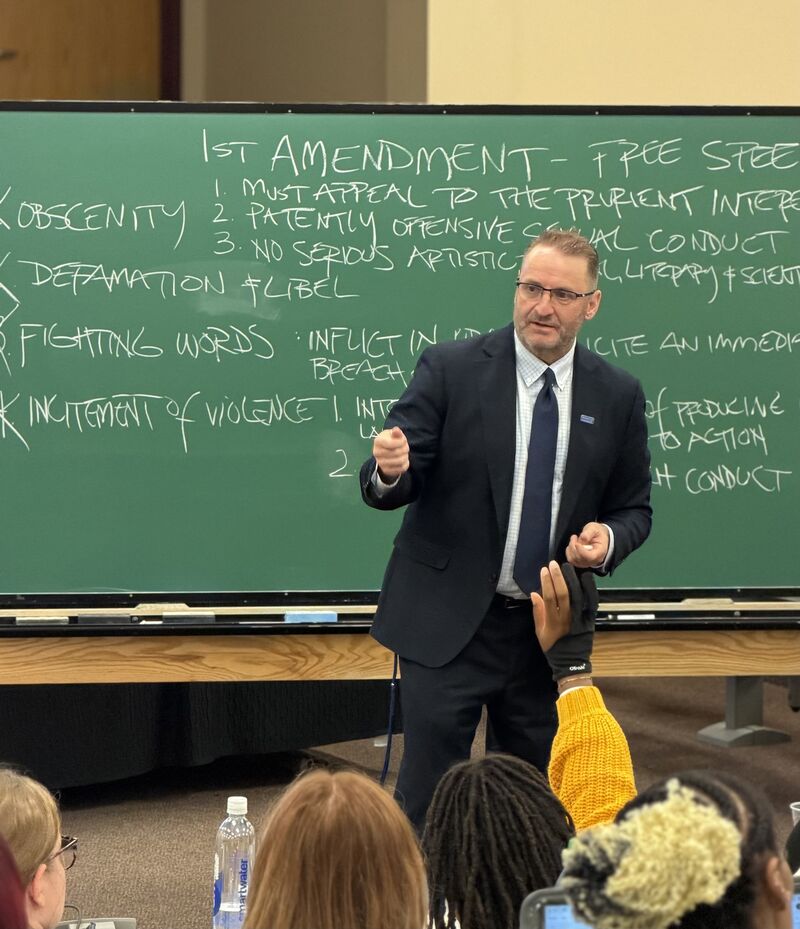
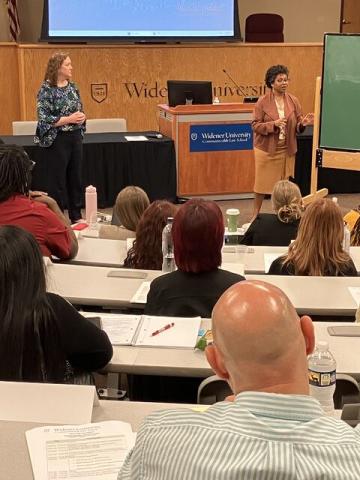
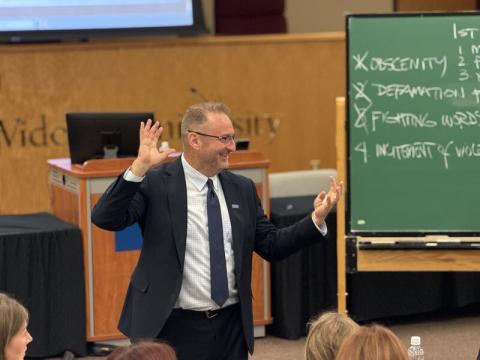
The event gave participants several ways to explore that experience. They took part in a mock First Amendment class taught by cummings, a visioning exercise led by Associate Professors Kellyn McGee and Rebecca Feldmann, an admissions presentation by Associate Dean Matthew Kerns, a current student panel and a campus tour.
For cummings, those experiences help participants recognize they belong in law school and can succeed without leaving behind the experiences that brought them there.
“They don’t need to change anything about themselves to become law students and ultimately lawyers,” he said. “We want their experiences in our classrooms. We want their background in our community.”
Fitisemanu and fellow Center for Equity and Justice fellows Haley Nelson and David Duggan organized the event. Nelson moderated the panel, which included Evans, third-year students Shemariel Gray and Michelle Ildefonso-Ruelas, and second-year student Sarah Heichel, a former Pathway participant.
For Fitisemanu, the program’s value began with making an unfamiliar process understandable.
Raised between Utah, California, Arizona and Samoa, she studied international relations and environmental and sustainability sciences at the University of Utah before spending several years in the tech sector. Her work included managing large-scale programs and events for companies including Google, Slack and The New York Times.
Even as she built her career, she kept returning to a desire to serve her communities.
“I wanted to figure out how I could do the greatest good in the most immediate time that I can for my communities,” Fitisemanu said. “Law school became apparent to me as the avenue I wanted to do that good in.”
Knowing why she wanted to attend, however, did not mean she knew how to get there. The Pathway Program gave her a structure for preparing for the LSAT, along with guidance and accountability.
“I didn’t really have any sort of direction or formative understanding of how to approach the LSAT at all,” she said. “The program structured things for me and made it very apparent what we were doing, why we were doing it, and how it would be applicable in a law school context.”
That preparation helped her build confidence before she entered law school. Once enrolled, her reasons for pursuing a legal education helped sustain her through the work.
“Law school is hard,” she said. “The material is challenging. It can be exhausting. But bringing all of myself, my experiences, my communities, and everything I hope for into every class and every paper gives meaning to why I’m here.”
Evans found his sense of belonging through the Appellate Advocacy Honor Society, where he worked with other students preparing for moot court competitions.
Together, his team worked through a difficult hypothetical constitutional issue. The preparation gave them a shared purpose, and the time they spent together developed into friendships that have lasted.
“I felt as if Widener Law Commonwealth was more than going to classes and studying my coursework,” Evans said.
He also wanted prospective students to understand that adjusting to law school involves learning a different way of approaching problems. Looking back, he wishes he had known more about how legal education would differ from his undergraduate experience, particularly its emphasis on analytical thinking.
His experience gave panel participants a view of what could come after admission: demanding coursework, opportunities to develop new skills and relationships built through working alongside others.
For Fitisemanu, helping prospective students envision that future has become part of her own law school experience. For cummings, having former participants assist in running the program brings a personal commitment to the work.
“They’re so committed to what the Pathway Program did for them that our participants want to give back to the scholars coming behind them,” he said.
In her application to become a Center for Equity and Justice fellow, Fitisemanu described the responsibility she feels to those who will follow her.
“The communities I represent are still not in these rooms, and the greatest impact of my existence here is in anticipation of those who enter even after me,” she wrote.
She hopes students considering law school understand that their paths do not have to look like anyone else’s.
“Everyone’s experience and their path is so different,” Fitisemanu said. “You’re not late, you’re not early, you’re not ahead of the game, you’re not behind. The will to do it and the discipline are all you need.”
Her advice is to pursue the work that matters to them, even when the next step feels difficult.
“Life’s hard in general,” she said. “You might as well choose the hard that’s worthwhile.”