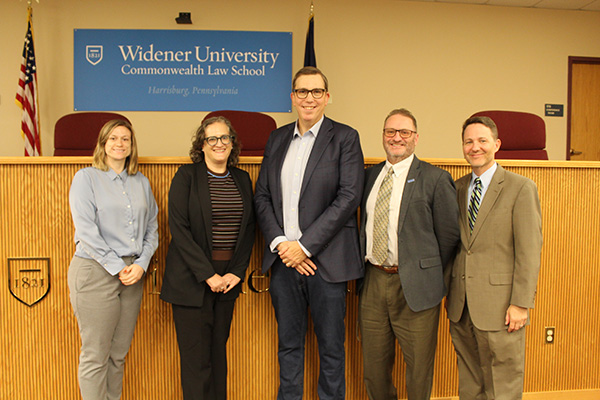
The U.S. Supreme Court’s history, constitutional responsibilities and relationship with the public took center stage Oct. 6 as legal scholar Stephen I. Vladeck addressed about 250 people at the John Gedid Lecture at Widener University Commonwealth Law School.
Students, attorneys and other guests filled the Douglas M. Wolfberg Courtroom and joined virtually for this academic year’s program, sponsored by the law school’s Law and Government Institute.
In welcoming attendees, Dean andré douglas pond cummings reflected on the legacy of Gedid, professor emeritus who began the institute, served as its first director, and for whom the lecture is named. He opened the law school as its first vice dean.
“John was a founding father of our institution,” cummings said.
The dean highlighted Gedid’s role in recognizing the opportunities the law school’s Harrisburg location could offer students and establishing its commitment to government law. The institute continues that work through specialized study, professional opportunities and public programs that bring students and the legal community together.
Third-year student Thea Homan, vice president of the Law and Government Student Society, introduced Vladeck, the Agnes Williams sesquicentennial professor of federal courts at Georgetown University Law Center. Vladeck’s scholarship focuses on the U.S. Supreme Court, federal courts, national security law and military justice.
His presentation examined how judicial independence, court procedures and communication impact the public’s confidence in the nation’s highest court. He drew on historical examples and ideas from a book he is writing about the court.
He encouraged attendees to consider the court as an institution within the broader constitutional system, beyond its individual members or the outcomes of particular cases.
That relationship has evolved throughout American history, he explained. Congress has shaped the court’s size, schedule and jurisdiction. Justices also once traveled around the country to hear cases, bringing them into regular contact with attorneys and the communities they served.
“You are an institution in dialogue with other institutions,” Vladeck said while describing that historical relationship.
He used those examples to explore how judicial independence and accountability have operated alongside one another.
“Independence is not an end. It is a means,” he said.
That independence, he explained, allows judges to carry out their constitutional responsibilities. In Vladeck’s view, public confidence helps support the court’s ability to fulfill that role, including when its decisions are unpopular.
He also discussed the importance of explaining the legal reasoning behind decisions, including rulings on emergency applications. Those explanations, he said, allow lower courts, attorneys and the public to understand and evaluate the principles guiding the justices, even when they disagree with an outcome.
The presentation included proposals involving the court’s docket and an inspector general who could monitor compliance with ethics and financial disclosure requirements. Audience questions extended the discussion to term limits, the court’s size and ways to assess public trust.
Vladeck emphasized the value of considering practical changes, even when they might not address every concern.
“I think we spend way too much time these days thinking that if we can’t do it the perfect way, we can’t do it at all,” he said.