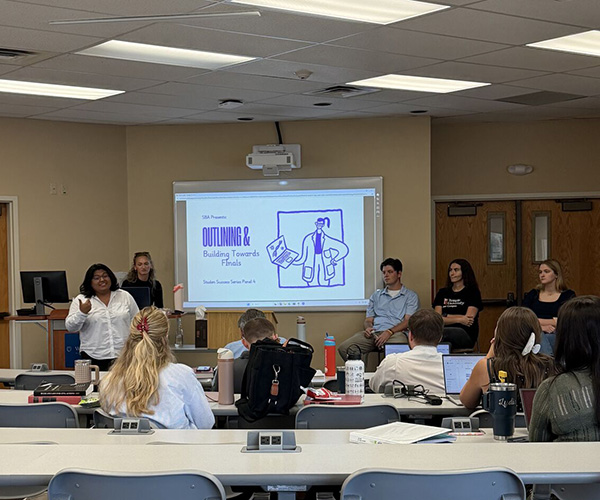
For first-year law students staring at weeks of class notes, case briefs and legal rules, creating an outline can feel like one more problem to solve. At a Widener Law Commonwealth Student Success Series program, five upperclassmen offered a reassuring message: There’s no single right way to do it.
During the panel, fourth-year student Margot Crouch joined third-year students Andrea Hernandez-Rodriguez, Paige Weaver, Haley Nelson and Joe Lennon to share how they turn a semester’s worth of material into outlines they can use to prepare for exams. Hernandez-Rodriguez is president of the Student Bar Association.
Their approaches varied, from detailed digital documents and color-coded notes to condensed “skinny or attack outlines,” handwritten rule statements and whiteboard exercises. The common thread was that an outline should help its creator understand the material, recognize legal issues and prepare to apply the law to a new set of facts.
“Your outlines are going to be unique to you because it’s a study tool for you,” Crouch said.
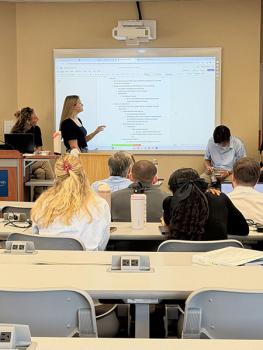
Crouch showed students both a full outline and a much shorter version containing the major rules and concepts she needed to remember. She described the condensed version as a “memory map” that helps her see the larger framework of a course and recall where more detailed information fits.
An outline can also take many forms. Students may use Microsoft Word, Google Docs, spreadsheets, handwritten pages, or even visual platforms such as Canva. What matters, the panelists said, is choosing a format that supports the way each student learns.
Weaver encouraged students to boil larger concepts into manageable pieces instead of simply transferring every class note into a new document. Her own outlines can be lengthy, but she begins with the major concepts and adds details as needed. She also considers how much class time a professor spends on a topic, which can offer clues about its importance.
“If you came from an accounting background, Excel might work for you,” Weaver said. “If you’re a little more creative, people make them on Canva. The importance is outlining in a way that works for you.”
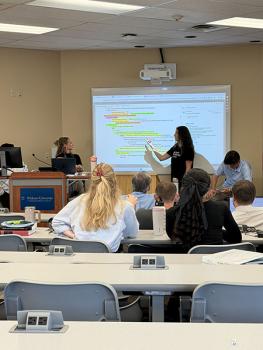
Nelson relies heavily on Google Docs and uses colors, bold text, larger fonts, and other visual cues to distinguish rules, issues, and points emphasized by a professor. She said those cues help her remember the material and identify language she may need on an exam.
Her preparation goes beyond reviewing the finished document. Nelson writes rules repeatedly on a whiteboard, then practices typing them from memory to mirror the experience of taking a timed exam. If she misses part of a rule, she starts again.
The goal is to enter an exam already knowing the governing rules and then concentrate on applying the facts, she said.
“When professors tell you that you should have the skeleton of your exam answer already written, that’s what they’re talking about,” Nelson said. “You should know the rules, and you should know the sub elements.”
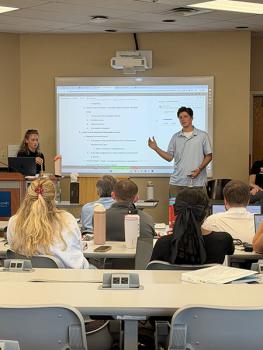
Lennon described an outline as a tool that should become more focused as a student gains confidence in the material. Once students commit a rule to memory, they can spend more time on concepts that remain challenging.
He also emphasized that much of the learning happens while creating the outline, not simply reading it afterward. Deciding what belongs, what to leave out, and where additional review is needed requires students to work actively with the material.
“The most utility of the outline comes from making it,” Lennon said. “No matter what it looks like at the end, the fact that you made it is 99 percent of the work.”
The panelists advised students to begin with the course syllabus, which often provides a framework of major topics. Textbook tables of contents, class notes, assigned readings, and hypotheticals discussed in class can also help students organize their material.

They cautioned against relying too heavily on outlines created by other people or commercial study aids, known as canned outlines. While those resources may help clarify a difficult concept or remind students of a topic, they may include rules or approaches that differ from what a professor taught.
Instead, the panelists encouraged students to seek help from their academic success fellows and professors. Students can ask questions about expectations, confirm their understanding of a rule and request feedback before an exam.
The conversation also turned to midterms, which the panelists described as an opportunity to evaluate study habits and adjust. A disappointing result, Weaver said, does not determine how a student will finish the course.
“I’ve still done well in the class because I stayed the course,” she said. “I didn’t let it knock me down. I had my little cry about it, and then I pivoted where I needed to.”
The panelists urged students not to compare their timelines or study habits with those of their classmates. Some students outline after each class, while others begin several weeks before an exam. Either approach can work if students remain current with their coursework and give themselves enough time to review and practice.
They also reminded students that preparation should include sleep, regular meals and time away from their books.
“You’re learning not just a completely new set of concepts, but an entirely new way of thinking,” Crouch said. “It’s hard, and it’s supposed to be hard, so give yourself a little bit of grace.”