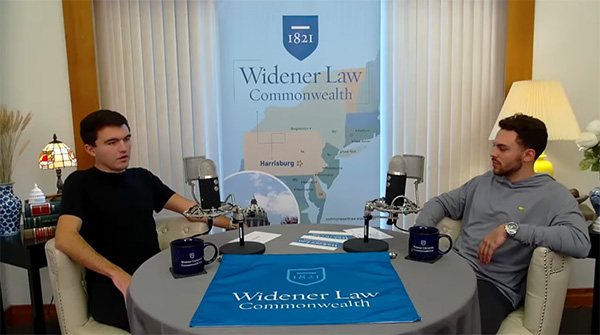
When Owen Dougherty and Enzo Fetsko arrived at Widener University Commonwealth Law School, they found a community willing to help them through the unfamiliar demands of their first year. Now they’re extending that same welcome through a podcast episode filled with the advice and encouragement they once needed.
In “What I Wish I Knew as a 1L,” an episode of the student-run podcast Late Night in the Library, the two entertainment law fellows share how mentors became friends, classmates helped them work through difficult material, and asking questions made law school feel more manageable. Their conversation reflects a Widener Law Commonwealth culture they experienced firsthand: Students who have been through the challenges are eager to help those coming behind them.
Now third-year students, Dougherty and Fetsko recorded the episode as 2Ls, with their first-year experiences still fresh. They talk candidly about being cold called on in the classroom and studying and finding time to recharge. They also remind listeners that they can take law school seriously while still making room for themselves.
“Do not lose yourself to law school,” Dougherty says.
For him, that meant trying to save part of his evenings to unwind, whether by watching a show or doing something else unrelated to class. Fetsko made the gym a regular part of his day and noticed when he stopped making time for it. Neither suggests that keeping those routines is always easy, but both encourage students to preserve something that helps them feel like themselves.
The same willingness to recognize what they needed helped them academically. Both found support through the school’s mentorship program, where advice about coursework grew into lasting friendships.
Dougherty remembers calling his mentor when he couldn’t make sense of an assignment. She helped him work through it and calmed his nerves. Fetsko’s mentor became one of his closest law school friends, someone he could turn to for everything from registering for classes to academic questions. He says signing up was among his best decisions of the first year.
That support reflects the community Dougherty felt from the moment he arrived on campus. Students who had already been through the first year were willing to answer questions, and he and Fetsko want incoming students to feel comfortable approaching them, too.
Sometimes, though, the most useful conversation is with the professor teaching the course. Fetsko wishes he’d made greater use of office hours during his first semester. The two encourage students to seek clarification from professors and academic support fellows rather than sit with confusion.
Learning what each professor expects also takes practice. One might focus on a case's facts; another on the court’s reasoning. A reading that takes an hour could lead to a brief classroom discussion, while another case might occupy several classes. Understanding those differences helped Dougherty and Fetsko prepare more effectively.
Cold calls brought their own adjustment. Fetsko remembers feeling nervous about answering questions in a large classroom, but the experience was rarely as bad as he’d anticipated.
“The person next to you is just as anxious to get called on as you are,” he says.
They remind listeners that classmates are often worrying about their own answers, and a stumble that feels unforgettable in the moment may barely register with anyone else.
Outside class, the two developed different study habits. Fetsko uses outlines to condense and organize his notes. Dougherty relies heavily on his notes and finds that writing concepts out by hand helps him learn. Both have changed their approaches as they’ve gained experience, and neither sees a classmate’s longer study hours as a reason to abandon what works.
Their clearest advice about legal writing comes from experience: Start when the professor tells you to start. The assignments demand more time than papers they wrote in college, and putting them off leaves students with less room to work through problems and revise.
They also urge students to treat disappointing grades as a reason to meet with professors, review their exams and adjust. A difficult first semester doesn’t settle how the rest of law school will go.
The podcast episode offers a candid look at the work and the people who can help. Current 1Ls may recognize the uncertainty Dougherty and Fetsko describe, along with the small signs of progress that are easy to overlook. Cases that once required repeated readings become easier to follow. Classroom expectations become clearer. Asking a question gets a little less intimidating.
And for students with questions the episode doesn’t answer, their invitation is simple: Stop them in the hallway and ask.