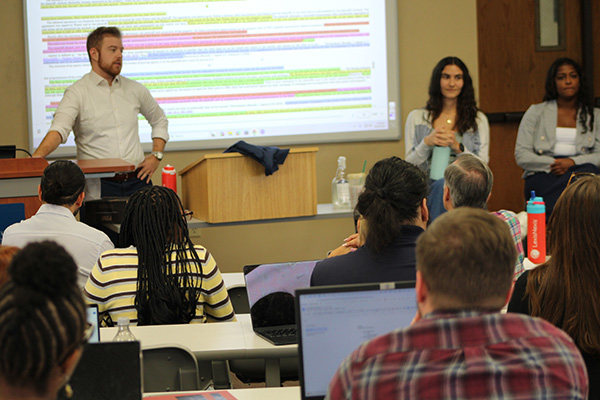
A law student’s first case brief may be too long, miss the point or look nothing like the one that student writes a year later. That isn’t failure, a panel of third-year students told their first-year classmates. It’s part of learning how to think like a lawyer.
The panel opened the Student Success Series on Aug. 26 at Widener University Commonwealth Law School. Third-year law students Haley Nelson, Nia Ramsammy, Gabrielle Hubbard and Cade Kassay shared the habits they’ve developed for reading cases, preparing briefs and building outlines.
Their approaches weren’t identical, and that was the point. Students need to put in the work, pay attention to what helps and give themselves time to improve.
Student Bar Association President Andrea Hernandez-Rodriguez, also a third-year student, said the series follows the first-year curriculum, with sessions timed to help students navigate legal methods assignments, class participation, midterms, finals and other milestones throughout the semester.
Nelson began by showing students one of her earliest briefs alongside a more recent example. The comparison offered a glimpse at how much a briefing method can change with experience.
“Do whatever feels right for you,” she said. “I’m not saying follow my template.”
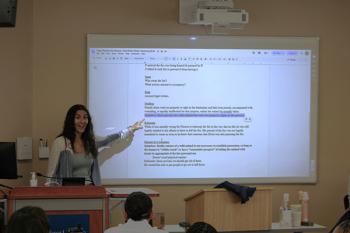
Nelson prefers to work digitally. She highlights cases in her online textbooks, using different colors to identify the issue, the parties’ arguments, the rule and the court’s holding. Sometimes she highlights an entire case before building her brief. Other times, the brief takes shape as she reads.
Whatever the method, Nelson said students should come to class having read the material and made a genuine effort to understand it.
“Come with your best effort,” she said. “If the professor can tell that you did the reading and you’re trying, they’re not going to get mad at you if you get it wrong.”
Ramsammy’s color-coding system is similar, but she prefers physical textbooks. Having the pages in front of her makes it easier to find and organize information.
The difference between their methods reinforced a point the panelists returned to throughout the hour: A strategy that works well for one student may not work for someone else. It may not even work equally well in every class.
“Every teacher is different,” Ramsammy said. “You’re going to learn a lot of different ways to do a lot of different things here. Eventually, you’ll learn and adapt your own style.”
She encouraged students to listen for patterns in the questions their professors ask. Those patterns may not be clear during the first few weeks, but they can eventually help students recognize which facts, arguments or opinions deserve the most attention in a brief.
Ramsammy also recommended including page numbers so students can quickly return to important language during a cold call or class discussion. When students aren’t sure what to prioritize, she suggested taking a brief to office hours and asking the professor for guidance.
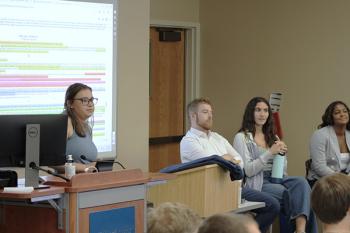
Hubbard focused on making complicated cases easier to understand. She also uses color to separate the facts, issue, rule and holding, creating visual cues that help her move between her casebook and brief.
Early in law school, Hubbard often copied language directly from a case. When called on in class, she sometimes discovered that she could repeat the court’s words without fully understanding what they meant or how they applied.
Her briefs became more useful when she began putting cases into her own words and reducing complicated disputes to their most basic points. She could always return to the casebook for more detail, but the simpler version made it easier to follow the discussion and respond during a cold call.
“I can’t just have the language verbatim,” Hubbard said. “It has to be in my brain, the way my brain sees it.”
She takes a similar approach to outlining, reviewing and simplifying her notes after class while the material is still fresh. Over time, those notes become the foundation of the outline she’ll use to prepare for exams.
Kassay brought the conversation back to something that can be easy to overlook when reading assignments begin to pile up: taking care of yourself.
For him, reading a case is a process. He may read it once for a general understanding, a second time to identify the facts, issue, rule and reasoning, and a third time before class. Preparation matters, he said, but so do sleep, meals and time away from school.
Trying to finish every last piece of work by staying up until 5 a.m. isn’t helpful, he said, particularly when class begins only a few hours later.
Case briefing, reading and research are important, Kassay said, “but that will all fall apart if you’re not taking care of yourself.”
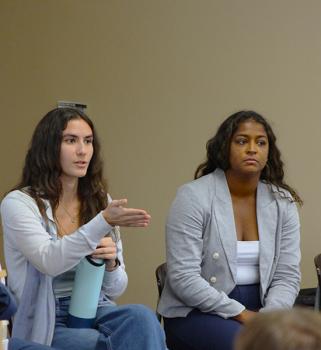
During a question-and-answer session, students asked about heavy reading assignments, cold calls, concurring and dissenting opinions, classroom hypotheticals and the time it takes to develop an efficient briefing method. The panelists recommended breaking large assignments into manageable pieces and seeking help from professors and academic success fellows. They also assured students that reading and briefing become faster with practice.
The Student Success Series continues throughout the semester with sessions on cold calls and class participation, Bluebook citations, outlining, multiple-choice strategies, essay writing and final exam preparation. Each program is designed to meet first-year students where they are in the semester and offer practical advice from those who have already been through it.
As Ramsammy reminded them, there is no single perfect way to brief a case or prepare for class.
“Your brief is for you.”