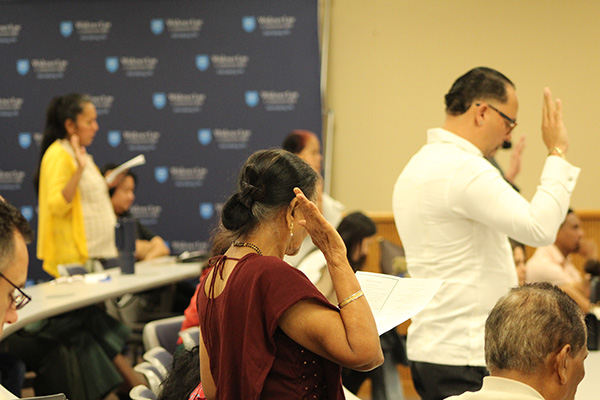
For the first time in its history, Widener University Commonwealth Law School became the setting where 35 people completed their journeys to U.S. citizenship, raising their right hands inside the Douglas M. Wolfberg Courtroom and taking the Oath of Allegiance.
The Sept. 18 naturalization ceremony brought the work of the federal courts directly to campus while giving students a firsthand look at one of the legal system’s most celebratory proceedings.
The new citizens represented 11 countries: Bhutan, Brazil, Canada, Colombia, the Dominican Republic, India, Mexico, Nepal, Nicaragua, South Korea and Vietnam. They arrived with family members and friends who filled the courtroom to share in the milestone.
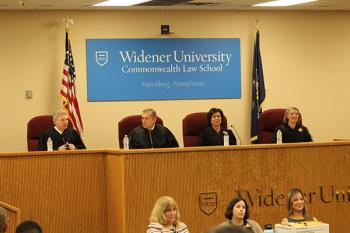
The U.S. District Court for the Middle District of Pennsylvania conducted the ceremony, with Magistrate Judge Susan E. Schwab ’92 presiding and welcoming the candidates and their families. She was joined by District Judge Jennifer P. Wilson, Chief Magistrate Judge Daryl F. Bloom, and Judge Henry W. Van Eck ’98 of the U.S. Bankruptcy Court for the Middle District of Pennsylvania.
“We are here today to conduct one of the most joyous duties we do as federal judges – a naturalization ceremony,” Schwab said as she welcomed the candidates and their families.
For Schwab, the day also marked a return to the law school where she began building her own career. A first-generation law student and the great-granddaughter of Italian immigrants, she earned her law degree from Widener Law Commonwealth 34 years ago.
“When you entered this courtroom, you were 35 citizens of 11 different countries, and now you are becoming citizens of the United States of America,” Schwab said. “You are fully ready to contribute your talents, ambitions and culture to the fabric of American life and participate in our democratic system of government.”
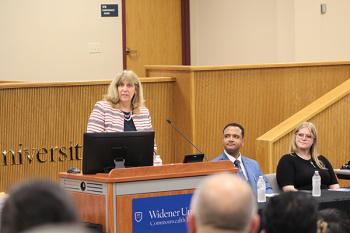
Associate Dean for Academic Affairs Anna Hemingway welcomed the candidates and their families on behalf of the law school. The ceremony held special meaning for Hemingway because both of her parents were naturalized citizens.
She told the new citizens that she grew up with a strong understanding of what American citizenship meant to her family. Her father escaped Russia before coming to the United States, and both of her parents went through the same naturalization process that brought the candidates to the Wolfberg Courtroom.
“Becoming an American citizen is much more than just a change in legal standing,” Hemingway said. “It’s really the culmination of a journey and the representation of new opportunities.”
The timing of the ceremony also carried significance. It took place one day after Constitution Day, which commemorates the signing of the U.S. Constitution on Sept. 17, 1787.
Wilson spoke about the freedoms guaranteed by the Constitution and the work each candidate put into reaching the day’s milestone.
“We celebrate you today, and we can all together also celebrate our Constitution and everything that it provides for all of us,” Wilson said.
Bloom encouraged the new citizens to take an active role in their communities by staying informed, participating in elections, helping their neighbors and contributing to the country they now officially call their own.
“Our democracy depends on more than just your certificate of naturalization,” Bloom said. “It depends on you.”
After a U.S. Citizenship and Immigration Services officer presented the candidates to the court, the 35 men and women stood together, raised their right hands and repeated the Oath of Allegiance. With its conclusion, they officially became U.S. citizens.
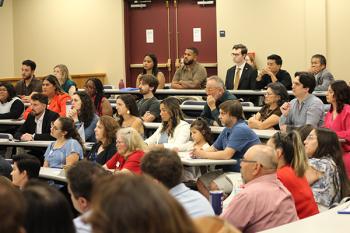
For students watching from the courtroom, the ceremony offered a chance to see the law move beyond textbooks and court opinions. The proceedings showed how the Constitution, the federal courts, and the legal profession can become part of a milestone that changes the course of a person’s life.
Raul Santana Nunez, associate director of special projects at Widener Law Commonwealth, understands that moment from personal experience.
Santana Nunez came to the United States from the Dominican Republic in 2010 at age 15. He later stood where the candidates were standing and took the same oath. He recalled being so nervous during his own ceremony that he worried he might raise the wrong hand.
“My heart was pounding, my mind was racing, and in that shaky moment, I felt something settle inside me,” Santana Nunez said. “It was not just a ceremony. It was the public affirmation of a decision that had been growing in my heart since I was a kid.”
After high school, Santana Nunez joined the U.S. Army National Guard. He has now served for more than 12 years, an experience he credits with teaching him the values of loyalty, duty, respect, selfless service, honor, integrity and personal courage.
Those values, he told the new citizens, are also at the heart of good citizenship.
Santana Nunez spoke about the opportunities he found in the United States, including education, independence and the chance to grow as a mentor and leader. He also reflected on his mother’s decision to leave behind everything familiar to create new opportunities for her children.
As he looked across the courtroom, Santana Nunez reminded the new citizens that each person had followed a different road to reach the ceremony. Some arrived with children who will grow up knowing the United States as home. Others carried the hopes of relatives who could not be there to witness the moment.
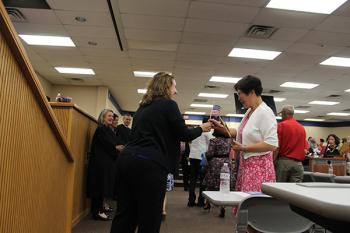
The ceremony concluded with the presentation of citizenship certificates, photos with the judges and a reception for the new citizens and their families.
“Whatever road brought you to this room, you now share something powerful,” Santana Nunez said. “Today, you join a long story of people who chose this nation, not because it is perfect, but because it is full of possibility.”