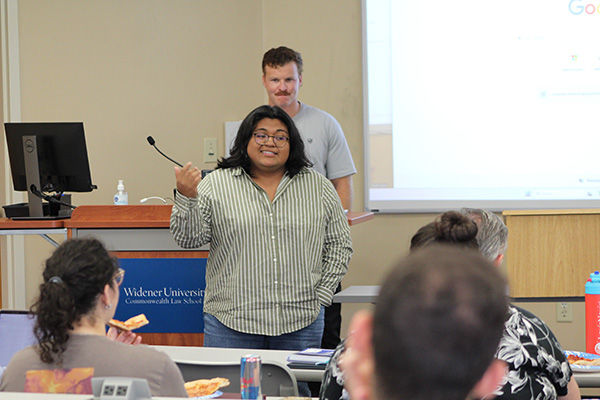
Cold calls can make even a well-prepared law student’s mind go blank. But according to a panel of third-year students at Widener University Commonwealth Law School, an imperfect answer is neither a disaster nor a measure of a student’s ability to succeed.
It is simply part of learning how to think like a lawyer.
The second program in the Academic Success Fellows’ Student Success Series focused on cold calls, class participation and effective note-taking. Student Bar Association President Andrea Hernandez Rodriguez joined third-year students Will Earhart, Olivia Hudak, Ryan Manderbach and Jake Gray to offer first-year students practical advice drawn from their own classroom experiences.
Their central message was reassuring: Do the reading, make an honest attempt, and do not let the fear of being wrong keep you from participating.
“You’re not going to crush it every time,” Earhart said. “If you mess up, you are going to remember it much longer than anyone else will.”
Earhart encouraged students to prepare for class by reading the assigned cases rather than relying solely on case summaries or other study aids. Preparation builds confidence, he said, even when a student does not have the perfect answer.
When a professor calls, Earhart recommended taking a breath before responding instead of rushing to fill the silence. Students who are especially nervous can also volunteer to answer questions early in class.
“Be confident, even if you don’t have the correct answer,” he said.
Cold calls may feel intimidating in the moment, but the panelists said they have a purpose beyond determining whether a student completed the reading. They help students test their understanding, practice applying the law and learn to respond under pressure.
Hudak recalled being called on several times in succession and being asked to read passages of case law aloud. The experiences made her nervous, but she said they also helped prepare her for the quick thinking required in legal practice.
“You can’t always have the answer in front of you,” Hudak said. “It makes you savvy, and it makes you well-spoken.”
She urged students to reframe the experience. Instead of viewing a cold call as something designed to embarrass them, they can see it as an opportunity to use the work they put into preparing for class.
“If you did all these hours of reading, a cold call is your opportunity to use that time and show what you know,” Hudak said.
Manderbach said a wrong answer can even reveal where a student needs to devote more attention before an exam.
“I would rather go into an exam knowing something I had a weakness in and could study than feel bulletproof going into an exam and look at the first question and say, ‘I don’t know how to get through this,’” he said.
Learning how to prepare for those classroom exchanges was another focus of the session. The panelists shared examples of their own case briefs and class notes, showing students how their methods became more organized and efficient over time.
Manderbach demonstrated how he identifies a case’s facts, issue, rule, holding and reasoning before class. He also marks those sections in his casebook so he can find them quickly if a professor asks a question.
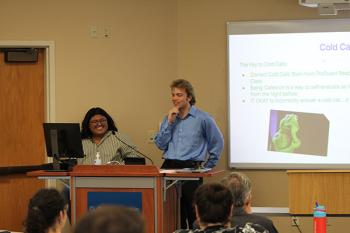
While he advised against relying exclusively on highlights in a textbook, he also cautioned students against writing briefs so detailed that they become difficult to use. His goal is to capture enough information to understand and discuss a case while keeping the brief as concise as possible.
During class, Manderbach records information a professor places on a slide or writes on the board. He listens closely for the rule of law and the way the professor applies it, since those details can later help him build an outline and work through practice problems.
“Being called on is a way to self-evaluate whether you understood the reading from before,” he said.
Several panelists warned against trying to record every word a professor says.
“Don’t try to be the court reporter,” Earhart said.
Instead, students should listen for the ideas that matter most and recognize that the skill develops with time. Different professors may use slides, write on the board or teach primarily through discussion, so students will need to adjust their approach from one classroom to another.
Hudak said she initially kept all her notes for a course in one long document, leaving her with pages of material that felt overwhelming when it was time to review. She later began using OneNote to organize courses by class meeting and topic. Color coding helped her separate rules and other important information from the rest of her notes.
She also reviews her notes and transfers the most important material into a shorter outline or flowchart. Revisiting the material throughout the semester, she said, makes it easier to understand how new concepts connect with earlier lessons.
“The more you touch your material, the better off you are,” Hudak said.
Gray gave students a side-by-side look at his notes from his first year and those he takes now. His early notes included nearly everything he encountered in a case. By his third year, they had become shorter, more structured and easier to turn into an outline.
Students should organize their notes in the way that makes the most sense to them, he said, whether that means dividing a document by subject, chapter or another system.
“It doesn’t matter if anyone else can read it best,” Gray said. “It matters if you can read it best.”
The panelists also encouraged students to pay attention to the questions each professor regularly asks. As the semester progresses, those patterns can help students anticipate what they will need to know about a case.
Class participation can help with that process. Raising a hand gives students practice explaining legal concepts and allows them to take a more active role in the discussion. It can also make an unexpected cold call feel less daunting.
The speakers acknowledged that law school can be competitive, but they urged students not to treat learning as a solitary exercise. Classmates can share a missed note, compare approaches and help one another work through difficult material.
“Use each other as resources,” Manderbach said. “It is competitive, and that’s kind of the nature, but it doesn’t have to be a negative thing. You can compete together.”