Learning the law will consume plenty of time over the next three to four years. Widener University Commonwealth Law School’s newest students were reminded Thursday that learning what kind of lawyer they want to be matters just as much.
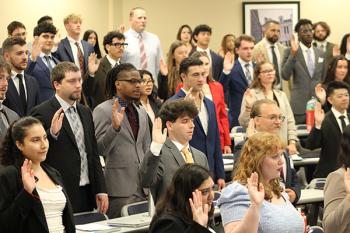
More than 200 incoming first-year students raised their right hands Thursday during the law school's annual Welcome to the Profession ceremony, pledging to uphold the values of integrity, civility, kindness and respect as they begin their legal education.
The ceremony marked one of the first milestones for the incoming class and carried a message echoed throughout the afternoon: Law school will teach students how to understand and practice law, but professionalism begins with how they treat the people around them.
"You are not simply beginning law school. You are beginning the process of becoming a lawyer, and those are two very different things," Dauphin County Judge La Tasha Williams told the class during her keynote address.
Williams, a 2018 Widener Law Commonwealth alumna, returned to the Douglas M. Wolfberg Courtroom where she once sat as a law student to administer an affirmation of professionalism to the incoming class.
She encouraged students to think beyond grades, class rank and legal knowledge as they consider what it means to be a good lawyer.
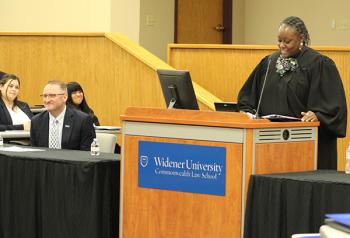
"Law school will teach you the law, but it is going to be up to you to decide what kind of lawyer you will become," Williams said.
At the center of that responsibility, she told students, are the people whose lives will one day intersect with their work.
"The law is your profession, but people are your responsibility," she said.
That message resonated with first-year student Steven Veronikis, a Harrisburg native and 2020 Bloomsburg University graduate.
"The affirmation of professionalism with Judge Williams was an important reminder of the discipline and necessary sense of duty we 1Ls must have in becoming attorneys and through our careers," Veronikis said.
He said the ceremony also reminded him of the responsibility lawyers have to the people they serve, particularly those experiencing some of the most difficult moments of their lives.
"A level of empathy in applying our intelligence will always be our best tool for personalization in resolving such matters," Veronikis said.
Williams also spoke candidly about her own academic struggles in law school and the professors who helped her find her footing. She urged students to advocate for themselves, seek help when they need it and resist measuring their abilities against the success of their classmates.
"Do not measure your intelligence by your class rank," Williams said. "And please, please do not let somebody else's success become evidence of your failure. There is room in this profession for all of us."
For first-year student Quinnlyn Reaver, taking the affirmation alongside her classmates was personally significant.
"As a little girl, I dreamed of becoming an attorney, and in that moment, it felt like the first step toward making that little girl's dreams come true," said Reaver, a West Middlesex, Pennsylvania, native and Westminster College graduate.
She said Williams' message about the relationships students begin building in law school also stayed with her.
"Be kind to your classmates; they could become someone that you can reference throughout your legal career," Reaver said.
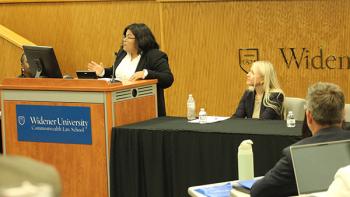
That sense of community was also at the heart of remarks from Student Bar Association President Andrea Hernandez-Rodriguez, a third-year student who welcomed the incoming class on behalf of their fellow students.
"Every person in this room has pictured this moment before," Hernandez-Rodriguez said. "Maybe not this exact room or these exact faces, but this moment, the moment where you stop imagining being lawyers and you start becoming lawyers."
She described Widener Law Commonwealth students as "kind go-getters" who understand that another person's success does not diminish their own. She encouraged the new students to "lock in and do good" by taking ownership of their education while continuing a culture of supporting one another.
"We check in with each other on tough days. We show up for events together. We lift each other up," Hernandez-Rodriguez said. "That is who we are. And that is who you are, too."
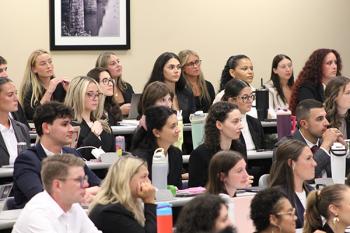
The incoming class is one of Widener Law Commonwealth's largest, with 204 students arriving in Harrisburg from across the country. The class represents 21 states, 51 undergraduate majors and 121 colleges and universities.
For first-year student Carolyn Amores, joining the class marks the realization of a goal she once wasn't sure would be possible.
Amores, who lives in Hillsdale, New Jersey, has worked in the legal field for nearly two decades and is balancing law school with a full-time job and raising two toddlers.
"Needless to say, it felt as though I was never going to be able to attend law school," Amores said.
She said a handwritten note from Dean andré douglas pond cummings that referenced her interest in family law, along with the recommendation of a Widener Law Commonwealth graduate she works with, helped solidify her decision to attend.
Nicole Boland '12 also reminded students that the relationships they begin forming in law school could last throughout their careers.
Boland, assistant chief counsel of litigation for the Pennsylvania State Police and a former Widener Law Commonwealth SBA president, asked students to look around the courtroom at their new classmates.
"You have no idea who you're sitting next to right now," Boland said. "You have no idea if you're sitting next to a future judge, a future law partner, a future expert in a field that you're going to need advice in one day."
She encouraged students not to count themselves or others out and to begin building a reputation grounded in respect and integrity.
"Your reputation as a lawyer follows you throughout your career," Boland said. "Your credibility as a lawyer is everything, and it starts now in law school, and it starts with how you treat each other."
Dean cummings reinforced the day's focus on community by reminding students of two expectations he has for members of the Widener Law Commonwealth community: Do good work and be good to one another.
"We don't harm each other. We accept each other. We live with each other," cummings told the class. "That makes it special. Unique."
The incoming first-year students now move from orientation into the work of law school with Williams' final challenge in mind: "Not simply to become a lawyer, but to become the kind of lawyer that this profession, this community and this country need you to be."