
“I think the easiest way to support one another is to just show up.”
Andrea Hernandez-Rodriguez ‘27
haz clic aquí para ver en español
Image
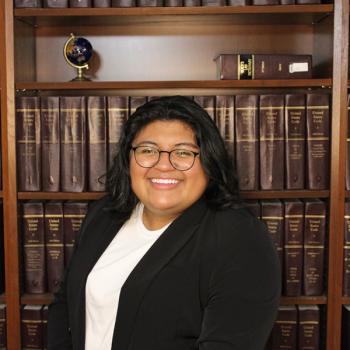
Andrea Hernandez-Rodriguez once searched her law school classroom for someone who might make it feel a little more like home. Now, as Student Bar Association president, she’s helping build the community she looked for when she arrived.
The third-year student at Widener University Commonwealth Law School remembers looking for other Hispanic students during orientation. Born in Mexico and raised in Lebanon County, she wanted to find classmates who understood something of her life before law school.
That connection came in a civil procedure class, when she turned around and met Michelle Ildefonso-Ruelas. They discovered they were both Mexican, and Hernandez-Rodriguez quickly decided they were going to be friends.
Other friendships followed, along with involvement in the Latin American Law Students Association, known as LALSA. Having people around her who shared her culture and experiences helped her settle into a place she’d worked hard to reach.
Today, Hernandez-Rodriguez, a member of the class of 2027, wants classmates to experience that same sense of connection. Sometimes that means helping a student turn an idea into an event. Sometimes it’s attending a program another organization spent weeks planning. Often, it starts with a hello, followed by the person’s name.
“I think the easiest way to support one another is to just show up,” she said.
She knows how much that support matters, because her own place in law school was not assured.
Hernandez-Rodriguez entered through the school’s Trial Admissions Program, a conditional admission opportunity that allowed her to demonstrate her ability to do the work. At the time, she said, it was her only path into law school.
“Widener chose me,” she said.
The program gave her an introduction to the material, the professors and the demands of law school exams. For someone who could get caught in her own head during testing, that familiarity helped. Just as meaningful was knowing professors were willing to spend their summer teaching students whose potential might not be fully reflected in an admissions score.
For Hernandez-Rodriguez, law school was not about chasing the top spot in the class. It has always been about the grit, passion, and work ethic that keep her moving forward, and the experiences that have affirmed she belongs.
Her interest in law grew out of watching immigration issues become part of her family’s reality and, later, working for a Lancaster nonprofit serving the immigrant community. She valued that work but wanted to do more.
What that would look like took time to figure out.
She initially imagined becoming a criminal defense attorney. A relative’s experience with the legal system had shown her how much access to representation could matter. But a judicial internship after her first year exposed her to the emotional weight of the work, especially cases involving young people.
She began reconsidering where she could best serve.
Then she took administrative law with Professor Jill Family.
The subject stayed with her long after the final exam. She liked Family’s teaching style and humor, and she found herself drawn to the intersection of legal reasoning, government, and politics. It was a field she wanted to keep exploring.
A state administrative law course with adjunct professor Joel Cheskis led to an internship with the Pennsylvania Office of Consumer Advocate, where she has been learning about utility law since the summer. She is pursuing an administrative and constitutional law certificate and earned a CALI award, which recognizes the highest grade in a course, in Family’s cutting edge law seminar.
Utility law wasn’t a career she’d pictured when she enrolled. Finding it has helped her see the value of remaining open to an unfamiliar subject, a professor’s suggestion or an opportunity she hadn’t considered.
That willingness to try something new has shaped her life outside class, too.
As a second-year student, Hernandez-Rodriguez served as LALSA treasurer and OUTLaw vice president. She helped bring drag bingo to campus, contributing to programming that gave students another way to gather and connect. The organizations are open to all.
Running for SBA president meant stepping away from organization leadership roles she loved, with no guarantee she’d win. She decided the chance to contribute across the school was worth taking.
Now, she helps students work through the practical details that can stand between a good idea and something their classmates can enjoy. When second-year student Brielle Kimmins proposed a permanent Wellness Corner, Hernandez-Rodriguez helped review the SBA budget and supported space for it. When another student wanted a basketball tournament, she helped with logistics while relying on his sports knowledge.
“I think all it takes is a conversation to get started,” she said.
She also makes a point of attending other organizations’ events. Having helped plan programs herself, she knows what it means when someone comes, brings a friend, or stops afterward to say the work was appreciated.
Her friends share that approach. They encourage one another to participate, talk with professors, and make connections across campus. Hernandez-Rodriguez values having people around her who see involvement as something worthwhile and who help make a demanding education feel less isolating.
After graduation, she’s open to opportunities in administrative law and beyond. She plans to bring the same grit and dedication to her legal career, while building a full life at home with her family and the wife she married in January.
For students still finding their footing, her advice comes from someone who has questioned her direction, changed course, and found reasons to keep going.
“It’s going to be OK,” she said.
She remembers hearing that as a first-year student and struggling to believe it. Now she wants other students to know that a meaningful law school experience is not defined by class rank or by winning every opportunity. It is built through hard work, persistence, and finding where you belong.
Interview was conducted in Fall 2026.


