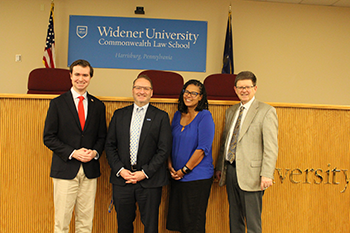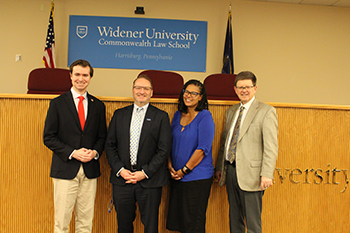
What does it actually mean for institutions, especially corporations, to take responsibility in moments that demand more than statements?
For andré douglas pond cummings, dean and professor of law at Widener University Commonwealth Law School, that question is at the core of the Dean’s Diversity Forum and the kind of legal education the law school strives to provide.
“This is about access. It’s about opportunity. And our diversity forum is about celebrating what is great about us, as a law school and as a nation,” cummings said, pointing to a community built on the idea that different perspectives lead to stronger outcomes.
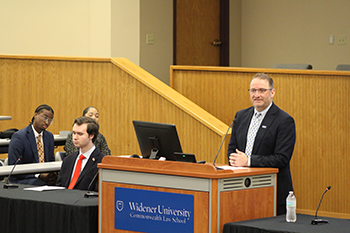
That approach shaped Widener Law Commonwealth’s 19th annual Dean’s Diversity Forum, where conversations moved beyond theory into something more personal, more urgent, and at times, more uncomfortable.
This year’s theme, “Corporate Responsibility Now!: Reframing Immigration and Repairing Historical Wrongs,” pushed panelists to grapple with a reality that resists easy answers. Responsibility, they suggested, isn’t just about compliance. It’s about choices, consequences, and who bears the cost when systems fall short.
Throughout the day, one idea kept resurfacing: corporations hold significant power. The real question is how, and whether, they choose to use it.
When harm isn’t abstract
For cummings, any meaningful conversation about corporate responsibility begins with history.
He pointed to the destruction of Tulsa’s Greenwood District, often called Black Wall Street, not just as an act of racial violence, but as a layered failure of institutions. After the community was burned to the ground, insurance companies denied all claims, leaving families and business owners with no path to rebuild.
The loss didn’t end there. It extended across generations.
“It wasn’t just what was taken,” he said. “It was what was never allowed to be rebuilt. The loss of generational wealth was profound and reverberates today.”
Students in the room were also thinking about how those historical decisions continue to ripple forward.
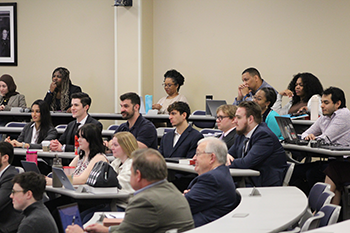
“What stood out to me the most was just how much our past continues to shape our present,” said David Duggan, a second-year law student. “We saw how actions taken by government and corporations decades ago continue to be felt today and continue to prevent all people from achieving the promises of our nation.”
For Duggan, one example in particular underscored the stakes.
“Those companies helped destroy generational wealth in the Black community,” Duggan said. “And [those companies] continue to exist today. That raises real questions about responsibility and what it means to repair harm.”
That perspective reframed the discussion. Corporate decisions, whether through action or inaction, don’t exist in isolation. They shape long-term outcomes, often in ways that are difficult to undo.
Responsibility, but on whose terms?
Jena Martin, professor of law at St. Mary’s University School of Law, challenged the idea that corporate social responsibility always reflects meaningful impact.
In many cases, she noted, these efforts are driven from the top down, shaped by leadership priorities, public pressure, or brand considerations. While some initiatives create real change, others risk addressing surface-level concerns while deeper issues remain untouched.
Corporate action, she suggested, often reflects what companies choose to prioritize or what they want the public to see.
That distinction matters. When responsibility is selective, so is its impact.
Immigration is not a silo
As the conversation shifted to immigration, panelists underscored how deeply intertwined these issues are with everyday business practices.
Jill Family, professor of law and associate dean for faculty research and development at Widener Law Commonwealth, outlined the many roles businesses already play within immigration systems.
They serve as employers navigating complex visa frameworks. They act as government contractors. In some cases, they participate in enforcement through hiring requirements. And they are part of the communities where immigrants live and work.
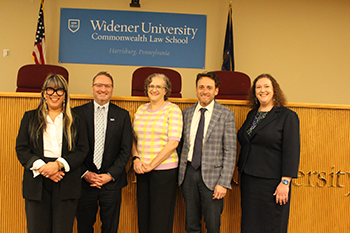
“There’s really no way to separate business from immigration,” she said, pointing to a system where legal structures, economic interests, and human experiences are constantly intersecting.
For first-year students, those connections are already starting to take shape in the classroom.
“As we learn the fundamentals of the rule of law, we’re starting to understand with more precision both the root and development of the issues we observe day to day, and where they can be challenged,” said Salamasina Fitisemanu, a first-year law student.
That reality raises difficult but necessary questions. When businesses are embedded in these systems, what responsibilities come with that role?
Complicity, silence, and the space in between
Panelists also pushed back on the idea that corporations can remain neutral.
Kim Vu-Dinh, professor of law at Mitchell Hamline School of Law, pointed to recent immigration enforcement efforts as an example of how businesses can become involved, whether as contractors, participants or observers.
In those moments, she suggested, companies are often making a choice, even when they frame it as inaction.
They can reinforce existing systems or challenge them. There is rarely a true middle ground.
That framing complicated the notion that responsibility is optional. In many cases, participation alone carries consequences.
A community that builds belonging
While the panels tackled large-scale systems, the forum also highlighted something closer to home.
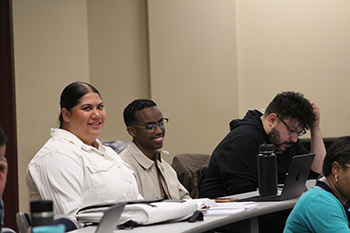
Students emphasized the role community plays in shaping future lawyers, through mentorship, support and shared experience.
Leaders from organizations such as the Black Law Students Association and Latin American Law Students Association spoke about creating spaces where students feel seen, supported and prepared to lead.
Their message was clear: belonging doesn’t happen by chance. It is built intentionally.
That sense of purpose carried through to the forum’s closing moments.
“The idea of fearlessness really stayed with me,” Fitisemanu said. “Even in new and complex situations, we can rely on our preparation and on principles rooted in the rule of law to pursue solutions and confront injustices.”
And for many students, that sense of belonging is what makes broader conversations about law and justice feel tangible.
“You belong,” one student leader said, reflecting on the impact of Widener’s Pathway Program and the work of the Center for Equity and Justice.
Where the conversation goes next
The forum didn’t aim to offer simple solutions. Instead, it created space for more honest, nuanced conversations about responsibility and the role of law in addressing systemic inequities.
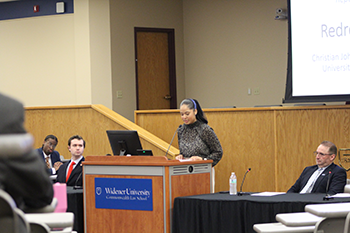
For students, that ongoing dialogue feels like a starting point rather than a conclusion.
“Change is slow, but it begins with a conversation,” Duggan said. “It’s important that we continue to have these difficult conversations so we can understand how to bring about the change we want to see.”
For cummings, that ongoing dialogue is the point.
Bringing different perspectives into the same room, he said, leads to stronger thinking, stronger advocacy, and ultimately, better outcomes.
And as the discussions throughout the day made clear, those outcomes don’t just shape institutions.
They shape lives.