Who is actually making decisions inside the executive branch, and what happens when those individuals do not formally belong to the government?
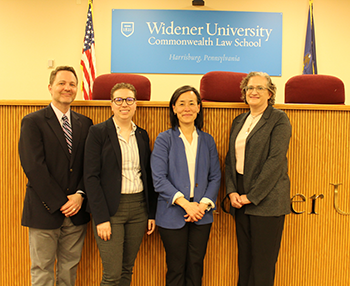
That question took center stage at Widener University Commonwealth Law School’s 2026 annual John Gedid Lecture, where University of Chicago Law School Professor Jennifer Nou introduced students to a concept reshaping how legal scholars understand executive power: the “para-presidency.”
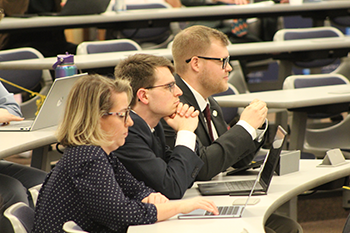
Delivered March 31 and sponsored by the Law & Government Institute, Nou’s lecture, “The Para-Presidency: The Department of Government Efficiency and Beyond,” examined a growing network of advisers and outside experts who operate close to presidential authority, often outside traditional systems of oversight and accountability.
Nou described the development as part of a broader expansion of executive power over time.
“There can be little doubt today that we are in the midst of the imperial presidency,” she said. “This development … has been the result of an accretion of power to the president spanning decades.”
Rather than focusing on a single administration, Nou traced a longer-term shift in how presidents pursue policy goals. Increasingly, administrations rely on short-term or nontraditional personnel, including special government employees, detailees, and individuals brought in through the Intergovernmental Personnel Act.
These para-presidential advisers and outside experts, she explained, can provide flexibility and specialized knowledge. At the same time, their roles raise questions about how authority is exercised and how oversight applies.
“What unites these para-actors … is that they operate alongside and in functional proximity to other formal actors … without sharing their legal status,” Nou said. “The root institution … can use them to accomplish acts that they otherwise would not be able to do.”
A central theme of the lecture was visibility. These advisers may influence decisions at the highest levels of government while still being classified as advisers, a distinction that can limit oversight and complicate legal review.
“Basic facts about the para-presidency’s size, scope, and the scale of duties exercised are simply unknown to Congress, academics, or the public at large,” Nou said.
For students, the discussion offered a new way to think about how government operates in practice.
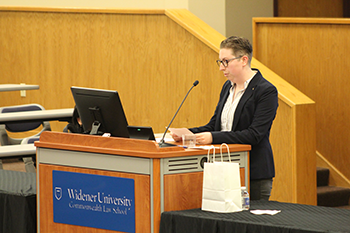
Alex Benson, a third-year law student in the class of 2026 and president of the Law & Government Student Society, said the lecture challenged her understanding of decisionmaking inside the White House.
“I found her lecture to be thought-provoking as it really made me question my own knowledge of how the White House is run,” Benson said. “Her analogy of the para-presidency showed how those around the president can have more influence than the public may realize.”
Jacob Russell, a third-year extended-division student, said the discussion of special government employees stood out.
“The constitutional implications of the current para-presidential advisory force of Special Government Employees are both interesting and concerning,” Russell said. “Some are making sweeping decisions that resemble the role of cabinet secretaries, but without the same level of oversight.”
Nou pointed to the Department of Government Efficiency, or DOGE, as a contemporary example, illustrating how temporary structures can be used to advance major policy initiatives. She also discussed potential challenges, including conflicts of interest, limits on judicial review, and questions about accountability once short-term advisers leave their roles.
At the same time, she emphasized that the use of outside expertise is not inherently problematic, particularly as policy challenges grow more complex.
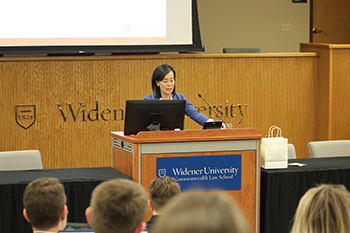
“I welcome the flexibility into government,” Nou said. “I do think there needs to be real thinking about how to get folks into government that wouldn’t otherwise serve.”
That balance between flexibility and accountability resonated with students, who connected the discussion to concepts explored in their coursework.
“This conversation took me right back to my administrative law course taught by Professor Lee Francis,” Benson said. “Executive power is something we studied in depth, and this added another layer to how I understand it.”
Russell said the lecture reinforced core legal principles related to accountability and structural limits on power.
“It raised important questions about how we increase oversight or address these issues when there isn’t a clear path forward,” he said.
The lecture also highlighted the practical value of Widener Law Commonwealth’s Law & Government Institute, which prepares students to engage with issues at the intersection of law, policy, and public service.
In opening remarks, Dean andré douglas pond cummings emphasized the institute’s role in preparing students for careers in government and regulatory practice.
“Our Law & Government Institute is one of our signature programs,” cummings said. “It focuses on the complex intersection of legislation, regulation, public policy, and the law.”
He added that the institute provides pathways into public service, particularly within state government.
For Benson, the experience reinforced the responsibility that comes with a legal education.
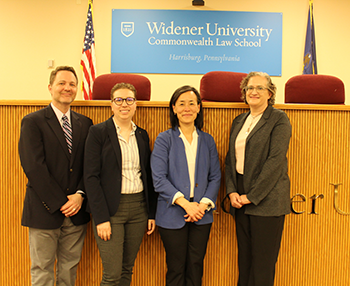
“There can be great power that comes with being in government, but power must come with accountability,” she said. “Lawyers have a responsibility to hold those in power accountable.”
The annual John Gedid Lecture honors one of the law school’s founding figures and continues to highlight issues at the intersection of law and government.