
From Utah to Tax Law: How Maxwell Merritt ’21 Built a Business-Focused Legal Career
Maxwell Merritt ’21
Image
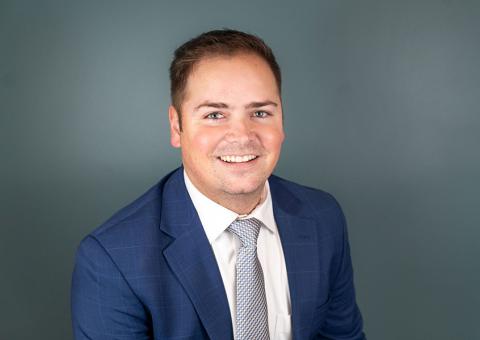
Before law school was ever part of the plan, Max Merritt ’21 grew up in Centerville, Utah, focused on sports and spending time with friends and family. The law was not something he was actively chasing. Instead, it entered his life quietly, through a relationship that would later shape his career.
As a high school student, Merritt had to complete a job-shadowing assignment and chose to shadow a family friend who worked as an attorney. That attorney, who Merritt now describes as a father figure, gave him an early look at the profession and planted the idea that law could be a meaningful way to help people navigate complicated decisions.
“That experience put the idea of law in my head,” Merritt said. “It stuck with me.”
Merritt went on to study economics as an undergraduate at the University of Utah, gravitating toward the business and finance side of the field. That academic background helped him approach law school with intention. Rather than seeing the law as a broad, abstract discipline, he knew early on that he wanted to work at the intersection of business, money, and planning.
That focus played a key role in his decision to attend Widener University Commonwealth Law School. Merritt said a personal connection with then-Dean Christian Johnson made all the difference. Johnson, who had ties to the University of Utah, personally reached out to Merritt and took the time to talk through what law school at Widener Law Commonwealth could look like for someone traveling across the country.
“Dean Johnson was the reason I chose Widener,” Merritt said. “He knew I was coming a long way and gave me opportunities and experiences I wouldn’t have had anywhere else.”
Those opportunities included working as a clerk for Johnson, whose background in tax and business law helped shape Merritt’s academic path. Merritt quickly realized he enjoyed classes that focused on how the law applies to businesses, finances, and long-term planning. He began enrolling in as many tax and business-related courses as possible, allowing his interests to sharpen naturally.
During the COVID-19 pandemic, Merritt’s interests turned into hands-on experience when he began clerking for Mark Kohler, a well-known tax attorney. The experience gave Merritt a clearer picture of what a business-focused legal practice could look like and confirmed that tax, business, and estate planning were the areas he wanted to pursue.
After graduating, Merritt said the biggest adjustment to practice was learning how to work directly with clients. In law school, success is often measured by reading, writing, and exams. In practice, it becomes about listening.
“You’re no longer just reading for a class,” he said. “You’re hearing someone’s real situation and figuring out how the law applies to their life.”
To deepen his expertise, Merritt later pursued an LLM in tax and wealth management, a master of laws degree that allows attorneys to develop advanced, specialized knowledge beyond a standard law degree. He said the decision was driven by a desire to fully understand tax law and build credibility as a tax attorney, with strong encouragement from his firm.
Today, Merritt is a senior attorney at KKOS Lawyers, where he works with clients on tax planning, estate planning, business structuring, and retirement strategies. His practice includes representing professional athletes and NCAA athletes navigating name, image, and likeness, or NIL, opportunities. NIL allows college athletes to earn income through endorsements and partnerships, often for the first time in their lives.
Merritt said relationships played a major role in entering that space. Personal connections with professional athletes and college athletics administrators helped open doors, while firm leadership encouraged him to pursue the emerging area of law. Much of the work overlaps with what he already does for small business owners, particularly athletes earning 1099 income, which means taxes are not automatically withheld.
“One of the biggest challenges is that this is often the first time they’ve had real money and real tax obligations,” Merritt said. “They don’t always have the financial literacy to know how to plan for that.”
A core part of Merritt’s work involves helping young athletes think beyond immediate opportunities and focus on long-term stability. Through retirement planning tools like Solo 401(k) plans, which allow self-employed individuals to save significant amounts for retirement, Merritt helps clients begin planning early, even at the start of their careers.
His day-to-day work varies, with five to seven client meetings each day covering everything from tax planning to estate documents and business formation. Merritt said his firm’s flat-fee structure allows him to focus on building long-term relationships rather than one-time transactions.
“I don’t want to work with someone once and be done,” he said. “We’re on the journey with them.”
Merritt remains connected to Widener Law Commonwealth and encourages students interested in tax, sports law, or nontraditional paths to ask questions and seek out mentors.
“That’s how I found my path,” he said. “Be willing to reach out, step outside your comfort zone, and learn what really interests you.”
Interview conducted in Spring 2026.


