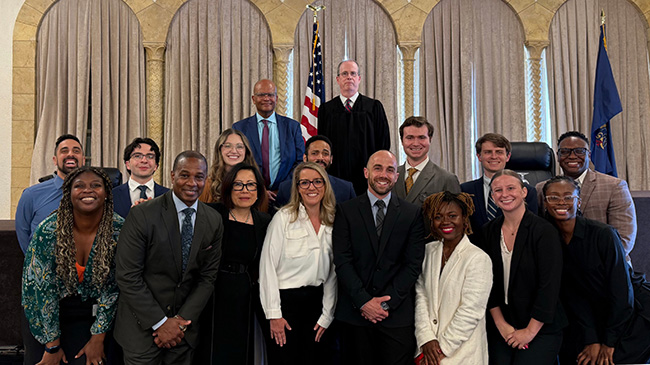
Widener Law Commonwealth students bring historic civil rights case to life at statewide judicial conference
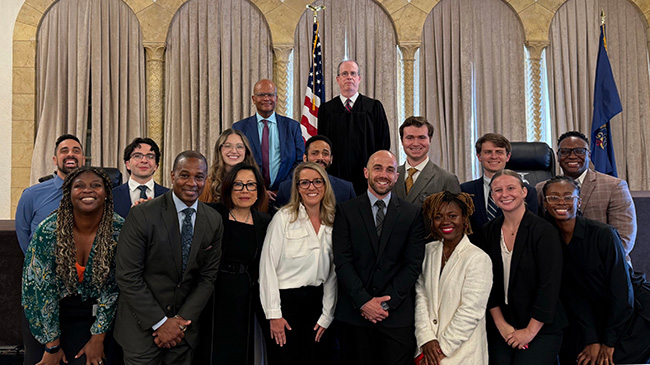
A powerful reenactment of a little-known 1942 extradition case that tested the boundaries of justice and race in America was staged this summer for an audience of Pennsylvania trial judges, brought to life by students from Widener University Commonwealth Law School. While it’s not a public performance, the production offered a unique educational experience for members of the judiciary.
The courtroom drama tells the story of Commonwealth of Pennsylvania v. Thomas Mattox, a case that pitted legal procedure against racial injustice and moral conscience during the Jim Crow era.
At the heart of the case is a courageous ruling by the Hon. Clare Gerald Fenerty, a Philadelphia judge who refused to extradite 17-year-old Thomas Mattox, a Black teenager accused of assault in Georgia. Mattox fled to Pennsylvania after being threatened with lynching in his home state, where he and his family had been attacked and arrested following an altercation with a white motorist.
“Judge Fenerty didn’t take the legally easy route,” said Pennsylvania Court of Common Pleas Judge Stella Tsai, who conceived the idea for the production. “He took a hard look at the case, considered the peril of mob action and the fundamental right to a fair trial, and refused to deliver Mattox to the representatives of Georgia. I thought it would be incredibly powerful to bring this story to life.”
The dramatization was adapted from court transcripts and historical research. The production features a full cast of Widener Law Commonwealth students playing real historical figures, including defense attorney Raymond Pace Alexander, one of the first Black judges in Pennsylvania and a civil rights pioneer.
For Tsai, the story’s relevance extends far beyond its mid-20th-century courtroom setting.
“We know from history, from the Holocaust to Jim Crow, that the rule of law can be exploited to suppress and destroy,” she said. “This play is a reminder that justice isn’t inevitable. It requires courage.”
Judge Royce Morris of the Dauphin County Court of Common Pleas is directing the student performance. “I’m incredibly proud of our students,” Morris said. “They’ve approached this project not just as actors, but as future lawyers grappling with issues of due process, equal protection, and what it means to truly serve justice.”
The cast is composed primarily of evening-division students at Widener Law Commonwealth, many of whom are balancing rehearsals with full-time jobs and summer coursework.
“These are some very good and thought-filled students,” said Professor Randy Lee, who helped facilitate the law school’s involvement in the project. “They’re adding this experience to already full plates, and they’re doing it with a remarkable level of insight and commitment.”
For rising third-year law student Dominick Resto-Harper, participating in the reenactment offered a reminder of the power the legal system holds to either uphold or deny justice.
“In today’s political climate, it’s easy to feel helpless,” Resto-Harper said. “This story reinforced how much power the judicial system has to change people’s lives. It took a lot of courage and bravery for Judge Fenerty to stay true to his convictions. It would've been easier for him to follow the governor's order and send Thomas back to Georgia, but he didn’t.”
Resto-Harperwas especially struck by the violence endured by Mattox’s mother.
“The most eye-opening part was learning that Sally Mattox was beaten by three men and had a chain wrapped around her neck just to get her to reveal her son’s whereabouts,” he said. “I hope judges and others in the audience are inspired to not let history repeat itself. In times of political extremism, people too often choose career over doing what is right.”
Though he hadn’t performed in years, Resto-Harper said it was an honor to be part of such a powerful production. “It was a privilege to take part in this with such an incredible cast,” he said.
Second-year law student Lelah Tehmeh learned about the opportunity through Widener’s Black Law Students Association. As someone with a background in theater and a passion for community service, she said the role felt like a perfect fit.
“I’ve always loved the arts and volunteering,” Tehmeh said. “To see I could combine my old love with law—in front of Pennsylvania judges—how could I decline?”
Tehmeh said the emotional weight of portraying a real person stayed with her.
“I played a real girl who had been beaten and jailed for the color of her skin and her family’s skin,” she said. “It was a hard pill to swallow. I wanted everyone watching to feel what she must have felt, testifying on behalf of her younger brother.”
The experience, she said, fundamentally changed how she views justice.
“One of the judges asked, ‘Is justice the right thing to do?’ and that stuck with me,” she said. “To most, the answer is yes. But that moment made me realize the importance of casting the first stone if you find it in your possession. If I don’t have it, I’ll guide those who do. That’s the only way change can happen—through dialogue.”
Tehmeh hopes the performance helps the audience remember the harsh realities behind the case.
“Remember our history. Remember the truth and how it still shows its ugly head to this day,” she said.
Second-year law student Aleigha Heimbach, who plays Franklin Barr, said the experience has been transformative.
“I was drawn to participate in this reenactment initially because of the opportunity to network with other legal professionals in the community,” Heimbach said. “I didn’t even know what the performance would be about when I volunteered, but I had done plays and musicals in the past and thought this could be a familiar way to get to know others in the legal field.”
She was surprised by her character’s combativeness.
“One of the most eye-opening parts was seeing how adamant and frustrated my character gets with the judge and the other side,” Heimbach said. “His frequent objections and attempts to downplay the serious risks the defendant faced were really shocking to me.”
The project, she added, underscored the role that societal forces can play in shaping legal outcomes.
“This experience has influenced the way I think about the law because it has given me a real-life example of how current events and societal influence can be incredibly powerful in the litigation of cases,” Heimbach said. “Judges have to consider the positive and negative implications of their decisions.”
As for what she hopes the audience takes away?
“I hope the judges and others in the audience are reminded that the law affects real people,” Heimbach said. “Cases aren’t just about making rules, they’re about people.”
John Young, also entering his second year of law school, plays an attorney advocating for extradition. For him, the role was an opportunity to challenge himself in unexpected ways.
“I became involved when Professor Lee explained to our class that there was a need for volunteers in some acting roles,” Young said. “I don’t recall knowing anything specific about the case at that time, but I’m from this area, so the thought of a local event with a few hundred trial judges sounded intriguing. It also seemed like a perfect opportunity to practice doing something that I abhor, public speaking.”
Young said his character, representing the Commonwealth, was a sobering reminder of how the law can be misused under the guise of neutrality.
“My specific role in this presentation is as an attorney who could hide behind the fact that he was ‘just doing his job,” Young said. “He was seeking to have Thomas Mattox extradited to a jurisdiction where he would likely have been lynched and certainly would not have had a fair trial. While my character obviously does not sell his position in that way, it is hard to imagine that this outcome was not apparent to him. Similarly to some current events, it is hard to imagine people acting in a way that is sure to cause great harm to other people, under the guise of ‘I’m just doing my job.’”
The lesson he takes from the case? Hope.
“Judge Fenerty’s courageous actions used the power of law to prevent a lynching,” Young said. “It reminds me of one of my favorite quotes from Professor Lee during my first year here: ‘Be careful that you do not conform yourself to the practice of law.’ Which to me was a warning not to lose sight of your values in order to go with the flow.”
Young hopes the performance leaves a lasting impression.
“I hope the takeaway is that being a good judge, attorney, or even human being is really just about doing what is right,” Young said. “This case is an example of a situation where the outcome of following the strict, literal interpretation of a law would not have resulted in fair justice. I also hope it empowers judges to use their discretion the way Judge Fenerty was able to and serves as a reminder that justice should take precedence over law.”
The performance is expected to spark meaningful conversations among the state’s judiciary about the enduring importance of judicial independence and racial equity. For the students, it’s a chance to participate in that conversation firsthand.
“This isn’t just a play,” said Tsai. “It’s a call to remember the kind of justice we should all be striving for, every day, in every courtroom.”