Judge Bianco to WLC Students: Your Legal Skills Will Matter When People Need You Most
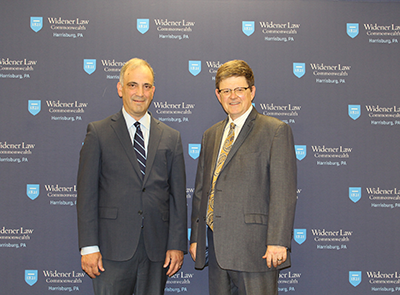
U.S. Court of Appeals Judge Joseph F. Bianco visited Widener University Commonwealth Law School recently for a talk that offered an inside look at the federal courts and judicial decision making. What began as a professional development event quickly turned into an interactive civics class that put students at the center of the story.
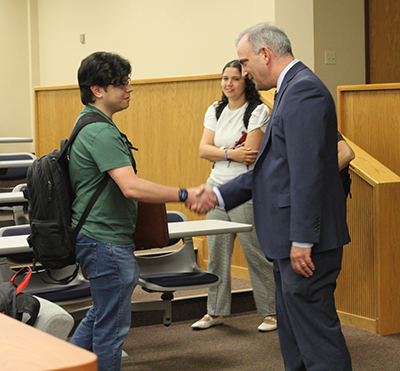 Bianco began with a lecture tracing his unexpected path from Columbia Law School to organized crime prosecutions, counterterrorism cases after Sept. 11, and ultimately the U.S. Court of Appeals for the 2nd Circuit. He told students he almost quit after his first year because of test anxiety and a fear of public speaking, but mentors convinced him to stay. In addition to his judicial service, Bianco is also an ordained deacon in the Roman Catholic Church. “You don’t know when your legal training will matter most,” he said. “There will be moments when people depend on your skills.”
After laying out that journey, he shifted into an engaging round of questions for the audience. The first quiz focused on Tinker v. Des Moines, the Vietnam War armband case about student speech in schools. When first-year student Audrey Confer identified the case and explained its holding, Bianco surprised her with a special prize, an armband signed by Mary Beth Tinker herself.
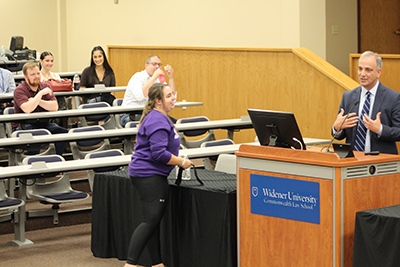 Confer, who grew up in Derry Township, said she didn’t expect to be part of the spotlight. “It was an assignment for Professor Family’s (civil procedure) class, so I wasn’t thinking much about what it would be, especially since I’ve never considered being a judge,” she said. “I suddenly flashed back to eighth grade when we first studied the Constitution. It was like a memory locked away in my brain, and I realized that learning about the Tinker case was one of the first times I realized how much I really love law.”
For her, the signed armband carried deep meaning. “In such a turbulent time of political uncertainty, it’s a beautiful symbol of the people who fought before you for the freedoms you have,” she said.
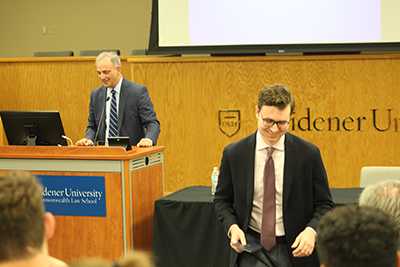 Other students joined the spotlight as well. When third-year student David Duggan explained the Michigan v. Summers rule that allows officers to detain occupants during the execution of a search warrant, Bianco handed him a pocket Constitution with a personalized inscription. A third student, 1L George Anderson of Union Beach, New Jersey, nailed the presidential trivia question about William Howard Taft being the only U.S. president to serve on the Supreme Court. His prize was a camp T-shirt from Bianco’s Justice for All civics program.
For Anderson, the moment carried a personal connection. “When Judge Bianco asked which president also served as a justice on the Supreme Court, it felt like the question was tailored for me,” he said. “It felt perfect answering in front of my classmates because they know how much I love U.S. history.”
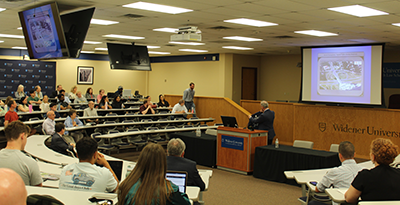 Anderson said his biggest takeaway from Bianco’s lecture was the judge’s emphasis on dignity and respect. “He treats everyone in court with dignity and respect, regardless of why they are there or what they have done,” Anderson said. “As a fellow Catholic, I related to his spiritual influence on his judging style. We need to start seeing the humanity in each other, and Judge Bianco serves as a stellar example of somebody who does just that.”
Dean andré douglas pond cummings welcomed Bianco by reminding students why face-to-face time with sitting judges matters. “It’s part of the fabric of a great law school to bring the bench to our community,” he said. “Judge Bianco sits one step below the U.S. Supreme Court, and hearing directly from someone who’s making decisions that shape our democracy is of critical importance.”
Professor Christian Johnson, who organized the program, said the night was designed to show both the craft of appellate judging and the unexpected ways legal careers can unfold.
Bianco walked students through cases involving free speech, search and seizure, and tribal sovereignty to show how judges approach complex questions. Between case studies, the giveaways and quizzes kept students leaning forward. “They didn’t just hear about precedent,” Johnson said. “They applied it in the room and saw how judges think through it.”
For Confer, the personal side of Bianco’s talk stood out just as much as the civics lesson. “As a Christian, I really appreciated his insight into combining faith with work,” she said. “It helped me to clearly see what kind of lawyer I want to be.”
Anderson echoed that reflection. “The ultimate reason for attending law school is to represent people who need assistance in a time of need,” he said. “One cannot properly assist someone going through perhaps the most difficult time in their life if they are cold and care only about writing an argument or receiving pay. Lawyers must also be there as a person who can empathize with their client.”
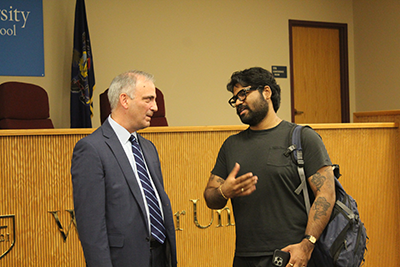 Bianco closed with a reminder of why these skills matter. “For most litigants, the court of appeals is the last stop,” he said. “That’s why clear records, focused issues, and respectful advocacy matter. And it starts with learning the cases well enough to explain them out loud, just like you did tonight.”