Widener Law Commonwealth EMS symposium highlights how law, policy, and leadership shape the future of emergency care
When most people think of emergency medical services, they picture a fast ambulance ride to the emergency room. Leaders who gathered at Widener Law Commonwealth’s Seventh Annual Emergency Medical Services Law and Policy Symposium on Jan. 15, said the reality is changing, and the legal questions around EMS are changing with it.
“This has become, in my tenure here, one of my favorite days of the year,” Dean andré douglas pond cummings told attendees during opening remarks. He described the symposium as an important place for law, policy, and EMS professionals to talk candidly about what communities need and what systems can realistically sustain.
This year’s theme, “Legal Pathways to EMS System Sustainability,” pulled together a multitude of leading expert voices who approached the challenge from different angles: evidence-based care, legal frameworks, leadership, and the human side of serving patients.
Keynote speaker Matt Zavadsky, an EMS and mobile health care consultant with the PWW Advisory Group, started with the big-picture shift EMS leaders are seeing nationwide. Many 911 calls are low-acuity, he said, meaning patients are unlikely to suffer harm if they do not receive an immediate lights-and-sirens response or an automatic trip to the hospital.
Yet many systems are still designed as if every call requires the highest level of response and transport. Zavadsky urged agencies to match the response to the patient’s needs, pointing to emerging models such as nurse triage, community paramedicine, mobile integrated health care, and treating certain patients in place.
The goal, he said, is not to do less. It’s to respond in a way that protects resources for true emergencies while reducing avoidable strain on crews and emergency departments.
Widener Law Commonwealth alumnus Douglas M. Wolfberg ’96, a founding partner of Page, Wolfberg and Wirth and an adjunct professor at the law school, picked up where the data left off. If EMS is shifting toward patient-centered models, he said, laws and regulations have to keep pace.
Wolfberg challenged long-held assumptions that can push clinicians toward unnecessary transport, including misunderstandings around liability, patient abandonment, and how EMS duties of care are defined. He emphasized that many rules on the books were written for a different era, when EMS was viewed mainly as transportation rather than mobile health care.
He urged leaders to bring legal and operational expertise to the same table, especially as states and local agencies consider new protocols, documentation requirements, and strategies to address ambulance offload delays.
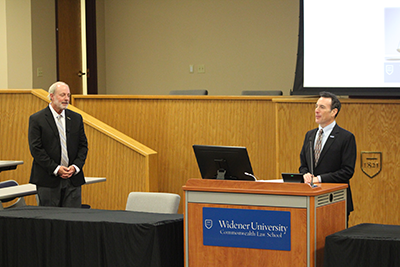
cummings also highlighted the strong alumni connection behind the symposium, thanking Wolfberg and his firm for their continued partnership with the law school. The program, he noted, was held in the Wolfberg Courtroom, and the law school will celebrate the courtroom’s naming during a ceremony on Feb. 20.
Professor Christian Johnson, dean emeritus, grounded the conversation in a reminder that EMS touches nearly every family.
“We all take for granted that at the most vulnerable points in our lives … EMS is going to be there,” Johnson said. The symposium, he added, is a chance to look honestly at what the public asks of EMS, and whether the current system is built to deliver long-term.
Stephen R. Wirth, an attorney, founding partner of Page, Wolfberg and Wirth, and longtime EMS leader, shifted the focus to the workforce. EMS has been quick to innovate with equipment and technology, he said, but slower to evolve in system design and in how agencies support their clinicians.
Wirth described a challenging stretch for EMS professionals, shaped by COVID-19, rising call volume, and growing public frustration. He also pointed to a common thread behind many complaints and legal disputes: not clinical skill, but communication and compassion.
He encouraged leaders to train and evaluate for what he called the four Cs: competent, communicative, collaborative, and compassionate care. Compassion, he noted, is not just a virtue. It can improve patient trust, reduce conflict, and help clinicians feel better about the work they do every day, especially when many calls are not the dramatic emergencies providers were trained to expect.
For prospective students, the symposium offered a clear example of how Widener Law Commonwealth connects legal education to real-world problems that affect public health, local government, and everyday life.
The program brought together attorneys, EMS clinicians, and policy leaders to tackle questions that do not have simple answers: how systems are funded, how they are measured, what laws shape decision-making in the field, and how leaders can build a workforce that stays strong through change.
In a field built on answering the call, the day’s message was consistent across sessions. EMS can’t rely on yesterday’s playbook. Sustainable systems will require smart legal frameworks, evidence-based care, and leaders who understand that the future of EMS depends as much on people as it does on policy.