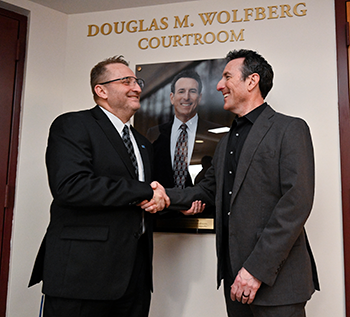
Widener Law Commonwealth Unveils the Douglas M. Wolfberg Courtroom
Long before his name was etched outside the courtroom, Doug Wolfberg was a student sitting inside it, navigating grief, uncertainty, and the demanding first steps of a legal education that would ultimately change his life.
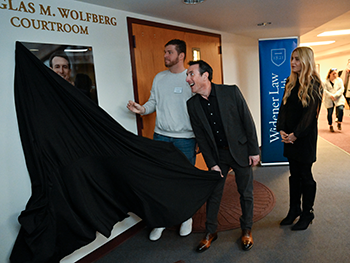
On Feb. 20, Widener Law Commonwealth unveiled the Douglas M. Wolfberg Courtroom, honoring Wolfberg ’96 and his wife, Tina, for a $250,000 gift, the largest single-donor contribution in Widener Law Commonwealth’s history. Yet the ceremony felt far less like a celebration of a dollar amount and far more like a tribute to what happens when opportunity meets resilience.
As a law student, Wolfberg lost both of his parents within months of each other. There were moments, he shared, when he wasn’t sure he could continue. Faculty made space for him to stay. The institution helped steady him. He graduated, built a career, and never forgot the place that made it possible.
“This school was formative and foundational for me,” Wolfberg said. “It opened the door for everything I’ve been able to achieve. This is about creating opportunities for the next generation.”
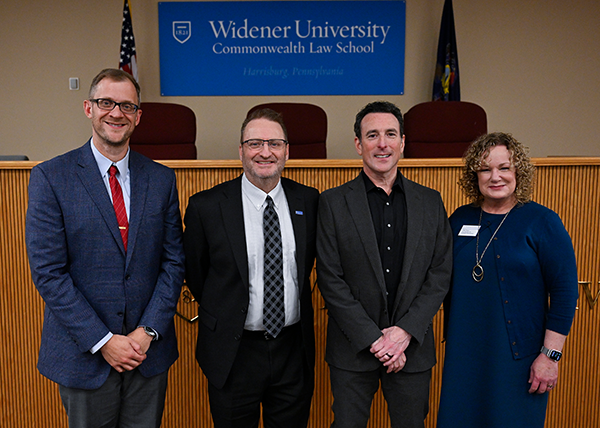
Dean andré douglas pond cummings described the courtroom not simply as a room, but as a training ground, a place where future lawyers learn how to serve clients in their most vulnerable moments.
“This isn’t just about a named space,” he said. “It’s about the kind of lawyers who walk out of here. It’s about service.”
Throughout the ceremony, speakers returned to a simple but powerful truth: access changes lives.
After graduating, Wolfberg began his career in big law before stepping away to build what would become one of the nation’s leading emergency medical services law firms, Page, Wolfberg & Wirth. The move required vision and risk. It also reflected the entrepreneurial spirit Widener Law Commonwealth works to instill in its students.
Vice President for Advancement Terry Travis described Wolfberg as a leader who goes first. When the university launched the quiet phase of its $75 million campaign in 2019, he made the first major gift. When the law school needed early backing for its 35th anniversary gala, he stepped forward again. His latest gift, she said, is tangible proof that alumni investment shapes the student experience in real and lasting ways.
“Students will walk into this courtroom and feel that their dreams are within reach,” Travis said. “They will know there is a community behind them.”
The courtroom represents more than a name. It is where trial advocacy unfolds, where arguments are sharpened, where confidence is built. It is a space where students test their voices and begin to see themselves as advocates.
cummings reflected on the generations who have sat in those seats, ambassadors, judges, public servants, firm leaders, and reminded the audience that what unites them is not title, but purpose.
“Everyone who has sat in these seats has been trained to use the law to help people,” he said.
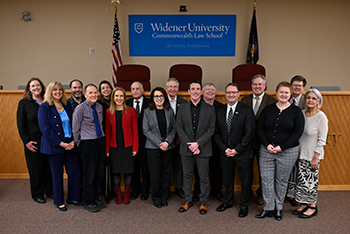
Wolfberg’s story underscores that promise. He arrived with ambition and uncertainty. He left with a profession and a calling. Decades later, he returned not simply to honor his own journey, but to make sure others have a path forward.
In his remarks, delivered with characteristic humility and humor, Wolfberg thanked the professors who steadied him, the classmates who sustained him, and the family members who filled the room that evening. He described the gift as partial repayment for a debt he can never fully repay.
“When you climb up,” he said, “you send the ladder back down.”
As the program concluded, attention turned to the students seated throughout the courtroom, many of whom will soon argue cases, negotiate contracts, and represent clients of their own. For third-year student Rishi Nayee, who also serves as a development liaison in the Office of the Dean, the message felt personal.
“What stood out to me was that this gift was more than just a name on a door,” Nayee said. “It was a message. Widener Law Commonwealth opened doors for him, and now he’s opening the door for others to give back. That idea of passing the ladder down really resonated with me. It shows us that we’re capable of real success, and that we have a responsibility to give back to the place that helped launch us.”
Hearing from someone who once sat in the same classrooms made it real in a different way.
“It lands differently coming from an alumnus because it’s proof, not a theory,” Nayee said. “Mr. Wolfberg sat in our classrooms, learned from our professors, faced the same pressures we face. He went through hardship, overcame obstacles and built an incredible career. Seeing that makes it feel possible for us, too.”
For fellow student Ely Zeigler, a Center for Equity and Justice fellow and Student Bar Association president, one of the most moving moments came when Wolfberg reflected on the professors who shaped him three decades ago, several of whom Zeigler has had himself.
“Ironically, I think the most powerful part wasn’t when he mentioned the room,” Zeigler said. “It was when he talked about Professors Randy Lee, Robert Power, Susan Raeker-Jordan, and Robyn Meadows. What makes this school special are the top-of-the-line faculty members who care so much about students and give us such a strong foundation. Doug is exhibit A that this school creates powerhouse lawyers.”
One moment, in particular, connected the past to the present.
“When Professor Meadows told us during 1L year that she had once been interim dean, I heard it, but I didn’t fully grasp it,” Zeigler said. “Then Doug shared that when he lost his parents during law school, it was then-Dean Meadows who helped him stay and finish. I already knew she was a great person. Hearing how she supported him in that moment made it even more powerful.”
For Zeigler, Wolfberg’s metaphor of sending the ladder back down came full circle.
“He talked about climbing the mountain and kicking the ladder back down,” Zeigler said. “I like to think Dean Meadows was doing that for him, and now he’s doing it for the next generation. He took finals in the same room I’m taking them in, written by the same professors I’ve had. I hope in 30 years, or sooner, I can give back too. Sometimes that helping hand makes all the difference.”
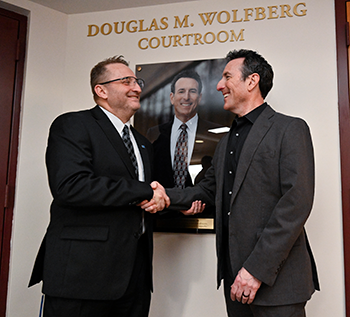
The Douglas M. Wolfberg Courtroom now stands as both tribute and invitation. It tells future students that where you begin does not limit where you go. It reminds them that resilience matters. That mentorship matters. That giving back matters.
And most of all, it signals that at Widener Law Commonwealth, no one climbs alone.