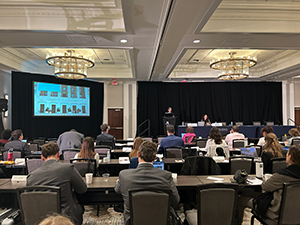
Widener Law Commonwealth Students Engage National Leaders at 56th Environmental Law Conference
When a group of Widener University Commonwealth Law School students participated in a recent environmental law conference held in the nation’s capital, they gained far more than access to a prestigious event. Immersed in discussions led by prominent practitioners, policymakers, and advocates, students had the chance to see environmental law unfolding in real time. Panels on emerging regulatory issues, climate litigation, and environmental justice offered the kind of real-world exposure that enriches and extends what they learn on campus.
“Not all legal learning occurs in the classroom,” said Assistant Professor D.S. Pensley, who co-directs the school’s Environmental Law and Sustainability Center with Assistant Professor Chiara Pappalardo. “Widener Law Commonwealth makes connections for our students and supports them in taking advantage of opportunities like this.”
Students who participated in the 56th annual Environmental Law Conference, hosted in Washington, D.C. by the Environmental Law Institute, included Nyvia Menakuru and John Young, both second-year students; and Nico Cavalari, a third-year student. William J. Rafferty, a second-year student and secretary of the Environmental Law and Policy Society, traveled to the conference in person.
Despite attending a renowned national conference as a law student, Rafferty never felt out of place.
“Most of the attendees were seasoned attorneys with years of experience,” he said. “I’m just a 2L with a long road ahead of me, yet I felt treated with genuine respect and professionalism.”
Rafferty was struck by the speakers’ accessibility after their panels and their openness to continue the conversation. A keynote panel on regulatory and judicial shifts reshaped his thinking about the field, particularly the role states continue to play in advancing environmental protections, even amid federal changes.
“At first glance, it can feel like environmental law is losing momentum,” Rafferty said. “But that’s not the full picture. In a lot of ways, federal rollbacks can open the door for state leadership and innovation.”
Sessions on disaster and incident response underscored that environmental law is not just policy driven. It often requires immediate and high-stakes problem-solving during extreme weather events, hazardous materials incidents, infrastructure failures and cyberattacks.
“The conference offered practical information that will be extremely useful in practice,” Rafferty said. “It felt like a behind-the-scenes look at how environmental law really operates.”
Menakuru, who attended virtually, found the programming equally impactful. A session on legal ethics explored through real-world hypotheticals the risks and responsibilities tied to generative artificial intelligence in legal practice.
“The discussion was engaging and highly relevant,” she said. “It was especially helpful to have the panelists walk through each hypothetical and explain the appropriate steps.”
Panels on climate litigation, renewable energy, and environmental justice reinforced what she is studying in class and showed how those concepts play out on a national scale.
“Participating in a national conference, even virtually, broadened my perspective and deepened my appreciation for the complexity and urgency of the issues at stake,” Menakuru said.
For Pappalardo, a co-director of the law school’s Environmental Law and Sustainability Center, connecting coursework to real-world applications helps students evolve from learners of environmental law into emerging professionals within the field.
“Whether in person or virtually, conference participation situates their classroom learning within the national conversation and helps them see where their work fits in the broader environmental and sustainability landscape. It also builds professional networks that can shape clerkships, fellowships and career trajectories in environmental practice,” Pappalardo said.
By the end of the conference, both students walked away feeling more certain about where they’re headed.
“As a law student, this experience reinforced my commitment to pursuing a career in environmental law,” Menakuru said.
Rafferty agreed.
“The conference helped me connect the dots between what I’ve learned in law school and how those concepts operate in practice,” he said. “It was a reassuring reminder that I’m on the right path.”