Jurist in Residence Lecture Tackles Trust, Independence, and the Future of the Courts
What does it mean to believe in the rule of law at a time when confidence in the courts feels strained?
That question didn’t stay abstract or confined to theory at Widener University Commonwealth Law School. Instead, it opened the door to a thoughtful, real-time conversation inside the Douglas M. Wolfberg Courtroom, where judges, lawyers and students came together to reflect on what’s at stake and how each of them plays a role in protecting it.
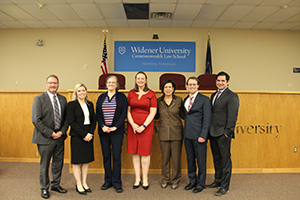
The law school’s 2026 annual Jurist in Residence Lecture, sponsored by the Law & Government Institute, brought together members of the bench and bar for a candid conversation on the state of the judiciary and the rule of law. The program was led by Jurist in Residence Karoline Mehalchick, U.S. District judge for the Middle District of Pennsylvania, and featured a discussion with alumna Susan E. Schwab ’92, U.S. magistrate judge for the Middle District of Pennsylvania and Sarah Hyser-Staub, litigation attorney and chair of the White Collar Defense, Public Corruption & Investigations Group at McNees Wallace & Nurick LLC.
The discussion opened quickly, shaped by questions, lived experience and a shared recognition that the rule of law is not something abstract. It is something people either trust or don’t, and that trust is being tested.
“The public’s confidence in the judiciary has been decreasing at an alarming rate in recent years,” Mehalchick said, pointing to a rise in hostile rhetoric and threats directed at judges across the country.
The discussion didn’t stay in the abstract for long. It moved toward what that reality looks like for the people doing the work.
The judges spoke candidly about the weight of carrying out their responsibilities in an environment where decisions are increasingly scrutinized, misunderstood or attacked. At the same time, they were clear about what cannot change.
The work, they said, has to remain steady, grounded in law and free from outside pressure.
“I think we should be putting our heads down and continuing to work as we have always worked,” Schwab said. “And to make our opinions as clear as we can, to show our work.”
That idea, showing the work, surfaced again and again.
For the panelists, clarity is not just about writing style. It’s part of how the judiciary earns trust. When decisions are transparent and understandable, it becomes easier to see that outcomes are rooted in law rather than bias or influence.
Mehalchick emphasized that point in practical terms, describing the effort to write opinions that reach beyond lawyers and judges.
“I want the person on the street to understand what it is I’m saying,” she said.
That commitment to accessibility connects directly to how the public experiences the legal system. If people can’t follow what courts are doing, it becomes harder to believe in the fairness of the outcome.
From the perspective of practice, Hyser-Staub framed the rule of law in equally practical terms. Lawyers rely on the stability and predictability of courts every day, long before a case ever reaches a courtroom.
“To me, one of the most important factors of the rule of law is that it’s an independent and unbiased application of the law,” she said.
That independence, the panel made clear, is not self-sustaining. It depends on how judges decide cases, how lawyers advocate, and how the public engages with the system.
The program attracted over 160 people, both in person and online. For students in particular, the message landed in a way that felt both immediate and personal.
“What stood out most to me was how genuine and student-focused it felt,” said Grant Villa-Rodriguez, a second-year law student and Patrick J. Murphy Law & Government fellow through the institute. “I expected it to be more formal given that the panel was made up of federal judges and well-known litigators, but it was the opposite. It felt less like a lecture and more like a conversation with people who genuinely wanted to guide us.”
That tone shaped how students engaged with the substance of the discussion. Brent Finkbeiner, a third-year student and Murphy fellow, noted that the panelists’ openness made it easier to connect with how these issues play out beyond the classroom.
“The panelists engaged openly with one another and with the audience,” Finkbeiner said.
At several points, the conversation returned to the human side of the law.
Finkbeiner said that perspective stood out most, particularly the emphasis on context and the real-world impact of judicial decisions.
“They spoke about the importance of looking at the full context behind a case and recognizing that judicial decisions affect real people and communities,” he said. “It reinforced the idea that the rule of law is not just abstract. It is something shaped by careful, human judgment.”
The panel also did not shy away from the challenges facing the judiciary, including the rise in political rhetoric and threats directed at judges. Even in addressing those concerns, the discussion remained measured and grounded, modeling the kind of professionalism the panelists urged students to carry forward.
For Villa-Rodriguez, the conversation became personal in a different way.
He pointed to Schwab’s reflections on her own path to the bench as a moment that stayed with him.
“Her story was very similar to mine,” he said. “She spoke about the long and difficult road it took to get where she is, and how it ultimately came down to effort and grit. Hearing that from someone at that level made it feel tangible.”
That sense of possibility, paired with responsibility, carried through the discussion.
Students were encouraged to see themselves not just as future lawyers, but as participants in shaping how the legal system functions, through their work, their judgment, and how they engage with difficult issues.
“I walked away with a stronger appreciation for both the responsibility and the humanity involved in being a lawyer,” Finkbeiner said. “Upholding the rule of law requires not only strong legal reasoning, but also empathy, perspective and a commitment to engaging with difficult issues in a principled way.”
The conversation also turned toward emerging challenges, including the growing presence of generative artificial intelligence in legal work. Judges and practitioners acknowledged both its potential and its risks, especially when it comes to accuracy and accountability.
Even there, the message stayed consistent. Technology may change how law is practiced, but it doesn’t replace judgment or responsibility.
Throughout the lecture, what stood out was not a single takeaway, but a shared understanding that the rule of law depends on people, on how they act, how they explain their decisions and how they respond when the system is tested.
For Villa-Rodriguez, that translated into a clear sense of direction.
“This profession demands a lot, but there is a path forward,” he said. “The rule of law depends on the people who step into it, and that includes us as students.
As the discussion came to a close, Mehalchick returned to the stakes in simple terms, leaving the room with a reminder that felt less like a conclusion and more like a charge.
“If the rule of law crumbles,” she said, “our democracy crumbles.”
The Jurist in Residence Lecture is one of the Law & Government Institute’s signature programs, offering unique access to leaders in the profession for students and continuing education credits for practitioners.