On most days, Kelly Monaghan ’26 helps oversee the operations of a major state regulatory agency. In the evenings, she studies administrative law, legal writing and the legal frameworks that shape the same systems she works within every day.
“It’s a little like channeling my inner Dory from Finding Nemo,” Monaghan said with a laugh. “Just keep swimming, just keep swimming.”
A fourth-year extended-division student at Widener University Commonwealth Law School, Monaghan serves as deputy executive director of the Pennsylvania Public Utility Commission, which regulates electric, natural gas, water, telecommunications and other essential utility services across the commonwealth.
Balancing both roles takes discipline and focus.
“I am a ruthless, absolutely ruthless, prioritizer,” she said. “I have zero tolerance for procrastination, so as soon as I find out about a deadline, I’m already working to meet that deadline.”
For Monaghan, law school has never been separate from the rest of her life. It has been layered on top of it.
Originally from Shenandoah, Pennsylvania, she earned a bachelor’s degree in history from Penn State. Public service was central to her upbringing. Her mother worked in education, rising from teacher to principal, while her father served as an undercover special agent for the Internal Revenue Service.
“Both of my parents, but especially my father, instilled in me the value of taking responsibility for the world,” she said.
She always planned to become an attorney, but her path shifted when her father was diagnosed with terminal cancer. At 29, she became his caregiver. He died the following year.

“Law school was always something I wanted to do,” she said. “But after that, life just got in the way.”
Years later, during the pandemic, she returned to that goal. By then, she had built a career in state government, working across mental health, auditing, and insurance, and developing expertise that blends finance, information systems and public administration.
At the Pennsylvania Public Utility Commission, she now helps manage day-to-day operations while overseeing multiple bureaus, including Administrative Law Judges, Audits, Consumer Services, Technical Utility Services, and the Office of Special Assistants.
“It is very interesting to have so many attorneys report to me while I’m in law school,” she said.
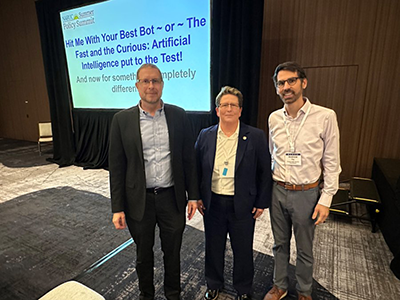
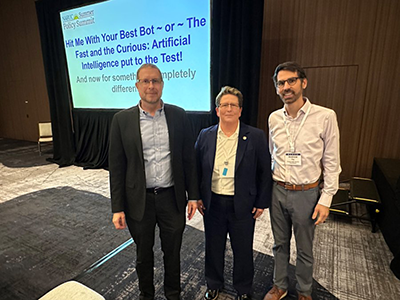
Her role places her at the center of one of the most pressing issues facing regulators: artificial intelligence.

“At the most basic level, AI is having an outsized effect on utility regulation,” she said. “It is being integrated into operations, and it is driving electrical load growth through data centers at an unprecedented scale.”
Her interest in AI is grounded in practice. Recently, she used AI to help analyze public comments tied to regulatory filings.
“It doesn’t take the place of a regulator reading each of the comments,” she said. “But it does help jumpstart the analysis.”
That experience led her to develop the AXIS Framework, a patent-pending approach to AI governance for public utility commissions. The idea emerged after her agency implemented a regulatory AI tool that showed promise but struggled with data quality.
“I realized I had just developed a map on how to do the thing and solve the problem,” she said.
Her work has earned national attention. This spring, she will participate in an AI and regulation program through the National Association of Regulatory Utility Commissioners, and has already spoken at national conferences and cybersecurity summits.
Her message is consistent: agencies must be proactive and thoughtful.
“We are going to be affected by AI,” she said. “So, the question is: How are we going to maximize the upside and minimize any harm?”
At Widener Law Commonwealth, Monaghan said her legal education has sharpened how she approaches those questions.
“I see things in layers, from the business perspective, the technical perspective and the legal perspective,” she said. “These are normally separate disciplines, but I’ve been able to integrate them into my decisionmaking.”
That integration has strengthened her work, but balancing both worlds has not been easy. She began law school as a bureau director and stepped into her current leadership role while continuing her studies.
“I have been blessed. I have a lot of energy,” she said. “I can concentrate for a long time. I can work for a long time.”
Still, she is candid about the challenge.
“I’m learning a tremendous amount,” she said. “But it is hard to engage in creative pursuits at the same time.”
Her experience with AI has also shaped how she views the future of legal education. While she sees value in the technology, she cautions against overreliance.
“I worry that things are going to be lost in translation,” she said. “The systems require an expert. If we’re not making experts, we’re going to have a problem as a profession.”
At the PUC, she founded a Technical Education Committee to help staff deepen their expertise while building confidence as leaders.
As graduation approaches, Monaghan is already looking ahead. After the bar exam, she plans to spend time with her wife, Natalie, and their daughter, Kara, and continue her work at the intersection of AI, infrastructure, and public service.
“I’m pro-AI,” she said. “But I also believe we have to have guardrails.”
By day, she helps shape decisions that affect communities across Pennsylvania. By night, she continues the work of becoming the attorney she always intended to be.