Jericha Brock ’27
Jericha Brock Is Using Law School to Help Rebuild Trust in Communities
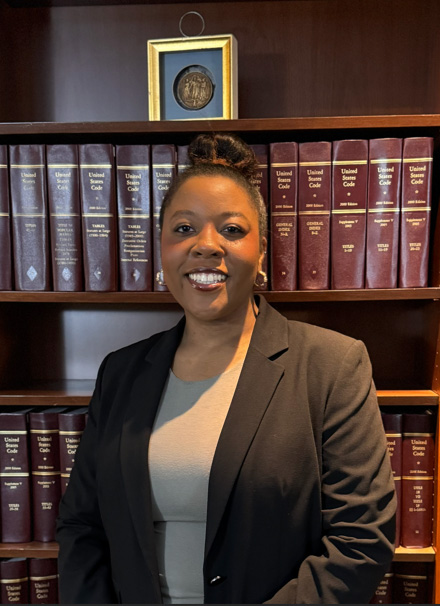 Some law students learn the law by studying cases. Jericha Brock is learning it by examining the systems that shape people’s lives long before they ever enter a courtroom.
Through Widener University Commonwealth Law School’s Center for Equity and Justice, the rising third-year student is helping research community policing practices and equity-centered initiatives designed to strengthen trust between institutions and the communities they serve.
“I knew I wanted to position myself to be of help for those in the community,” Brock said.
At Widener Law Commonwealth, that commitment has led Brock into work that extends well beyond the traditional law school experience. Through the Center for Equity and Justice, students engage in projects aimed at expanding pathways into the legal profession, strengthening communities, and examining how law and policy impact marginalized populations.
The center’s growing initiatives include the Pathway Program and Guided Journey PLUS Program, which provide free Law School Admission Test preparation and mentorship opportunities for aspiring law students from underrepresented, first-generation, and rural communities. The programs are designed not only to improve test scores but to help students build confidence, develop support networks, and envision themselves within a profession that has historically felt inaccessible to many.
The center also oversees the annual Dean’s Diversity Forum and supports student fellowships that connect legal education with hands-on, community-centered work.
For Brock, that work became deeply personal through her involvement in the Enhanced Community Policing Project, a collaborative initiative funded through a partnership with Walmart and conducted alongside the University of Arkansas at Little Rock William H. Bowen School of Law Center for Racial Justice & Criminal Justice Reform.
The project examines policing practices in low-income communities and communities of color, with the goal of improving community-police relations and promoting fairer enforcement practices. Brock and fellow students help research strategies designed to strengthen trust between law enforcement and the communities they serve, particularly in South Central Pennsylvania and the Arkansas Delta.
In December 2025, Brock and other fellows traveled to the Arkansas Delta to observe how their research was being implemented in real time, an experience she described as both grounding and motivating.
“To see the work that we have done being used in real time was impactful,” Brock said. “It encourages our team to continue to develop improvements to our work that would benefit those who implement the playbook and the people that they assist.”
The experience sharpened her understanding of the systemic challenges many communities face and reinforced the role lawyers can play in helping address them.
“It has been reinforced within me that nationally there are issues that need to be addressed which were previously not in my purview,” she said. “Each meeting about the project solidified my understanding that what we do will have a significant impact.”
Brock graduated from the University of North Texas in 2024 with degrees in human resources and entrepreneurship, intentionally choosing a path outside the traditional pre-law track. She wanted a broader understanding of the business realities surrounding legal practice while preparing for a future career in law.
She said Widener Law Commonwealth stood out for its smaller size, faculty accessibility, and location in Pennsylvania’s capital city.
“I felt that I would receive more focused attention and increased accessibility to the faculty,” Brock said. “And being in the state capital, I thought there would be opportunities to witness legislation at the state level.”
Soon after arriving on campus, Brock attended a gathering where Dean andré douglas pond cummings discussed his vision for the Center for Equity and Justice and the role lawyers can play in dismantling barriers that prevent communities from fully accessing justice and opportunity.
The message resonated.
Brock plans to pursue business law after graduation, potentially in an in-house role, though her time with the York County District Attorney’s Office also sparked an interest in litigation.
Still, she says success in the profession will never be measured solely by career advancement.
“Success would be helping as many people as I can,” Brock said. “The legal field is a space where many people can go without access because they lack the ability to ask for help or have those resources provided to them.”
She credits Professor Kellyn McGee as an important mentor during law school, describing the faculty advisor for the Center for Equity and Justice as generous with both guidance and time despite competing demands.
Balancing coursework, fellowship responsibilities, and professional commitments has required discipline and structure, Brock said, but she views the work as part of a broader obligation to serve others through the law.
That sense of purpose has become central to the kind of lawyer she hopes to become, one focused not only on professional success but on ensuring more people are able to see themselves reflected within the legal system itself.
When asked what advice she would give students considering involvement with the Center for Equity and Justice, Brock’s answer comes quickly.
“Join,” she said. “Each program has its own merits that will impact not only law students, but communities at large. You will not regret getting involved.”
Interview was conducted in Spring 2026.
Contact Information
Admissions Office
Phone: 717.541.3903
Fax: 717.541.3999
Email: [email protected]
CONNECT WITH US!