Dissent at the Center of the Conversation: Widener Law Commonwealth Hosts Annual Law Review Spring Symposium
Dissent is often uncomfortable. It can be disruptive, unpopular, even risky. But at Widener Law Commonwealth’s Annual Law Review Spring Symposium, one idea came through clearly: dissent is not a flaw in democracy. It is one of its most powerful engines.
That idea shaped “From 1776 to Today: The Evolution of Dissent in American Law,” a day-long program that brought together leading scholars, faculty, and students to examine how dissent has shaped the law and continues to define it.
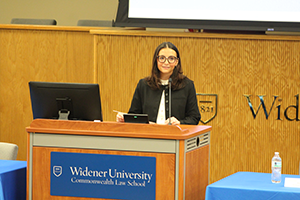
“Dissent has served as a safeguard of our democracy,” said Law Review Editor-in-Chief Kiera Flannery, who helped lead the symposium. “It ensures that citizens retain the power to question authority and advocate for a more just society.”
“What really impressed me about the symposium was the broad depth of topics that were covered, as well as the diverse viewpoints,” said Carey Anspach, internal supervising editor for the Law Review. “Despite the differing topics and opinions, the discussion remained respectful and professional.”
Behind the scenes, that level of engagement was the result of months of planning.
Flannery described the symposium as her “largest and most rewarding undertaking,” developed in collaboration with faculty advisor Professor Mary Kate Kearney. The idea began with an interest in the First Amendment and grew into a broader reflection on the 250th anniversary of the Declaration of Independence, ultimately shaping a program centered on the evolution of dissent in American law.
From building panels and recruiting speakers to coordinating logistics, continuing legal education credits, and programming, the process was extensive. Still, one moment stood out.
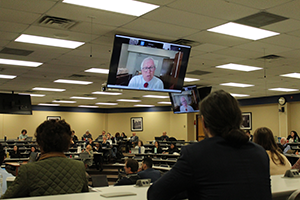
Inviting keynote speaker Erwin Chemerinsky, dean of the University of California Berkeley School of Law, felt like “shooting for the stars,” Flannery said. When he accepted within minutes, she knew the event would be something special.
That sense carried into the keynote itself.
“We don’t need the First Amendment to protect the speech that we like,” Chemerinsky said. “What we need the First Amendment to protect is the speech that we dislike, even the speech that we detest.”
Drawing on American history, Chemerinsky showed how often dissent has been tested, and sometimes suppressed, from the Alien and Sedition Acts to the Vietnam War. Yet time and again, dissent has also driven progress, from civil rights to modern protest movements.
Even as he explored difficult chapters in the nation’s history, Anspach said the message remained forward-looking.
“Although he discussed in great detail historical events that ran counter to this country’s ideals, he was still able to portray a hopeful outlook,” she said.
That balance between realism and optimism resonated throughout the day.
Flannery pointed to the energy in the room as one of the most meaningful takeaways.
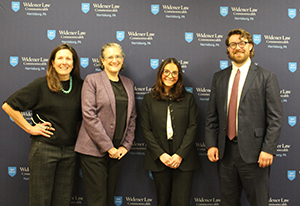
“In a society that is far too often polarized, it was heartening to see so many people from different walks of life gather together to celebrate one of the bedrock principles of this nation, the enduring idea of dissent,” she said. “People were engaged, informed, and respectful of differing opinions. That’s exactly what we hoped the event would be.”
Dean andré douglas pond cummings framed dissent not just as a constitutional principle, but as part of the law school’s identity.
“We are a law school that welcomes all voices,” he said. “Voices of the majority, voices of the minority, voices of discontent."
He pointed to the late U.S. Supreme Court Justice Thurgood Marshall, often called “the great dissenter,” as a reminder that the law is not just about doctrine, but about people.
“Oftentimes in American Supreme Court jurisprudence,” cummings said, “the dissenting opinion just needs one vote for it to become the majority.”
Across panels, that idea took on new dimensions.
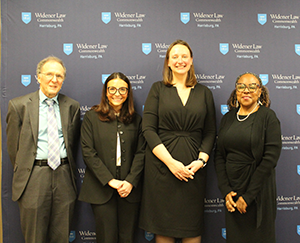
In one discussion, Noah Chauvin, associate professor of Law at Oklahoma State University College of Law, examined how the government defines domestic terrorism and the implications for free speech, emphasizing that political dissent sits at the core of First Amendment protection, even when it is controversial.
Another panel turned to dissent within the U.S. military, where Amy Gaudion, associate professor of law at Penn State Dickinson Law, explored how service members navigate expression in a system built on discipline and hierarchy, and why preserving meaningful channels for dissent is essential.
The final panel brought the conversation into the present moment.
Michael Dimino, professor of Law at Widener University Commonwealth Law School, raised concerns about rising political violence and the role rhetoric can play in shaping real-world outcomes, while reaffirming that dissent must remain protected.
“You cannot have a self-governing democracy without an exchange of differing views,” Dimino said.
At the same time, Lauren Gailey, assistant professor of law at Duquesne University Kline School of Law, examined how shifts in U.S. Supreme Court doctrine could reshape free speech protections, while Alan Garfield, distinguished professor of law at Widener University Delaware Law School, connected past and present, warning that modern threats to dissent often come through indirect pressure rather than outright censorship.
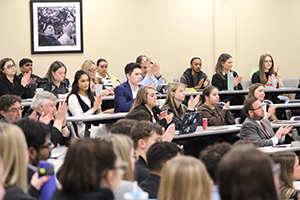
For Flannery, those conversations expanded her own understanding of dissent, particularly in the courts.
“Initially, I thought about dissenting opinions as tools for future change,” she said. “But the discussions also raised questions about their purpose, how they can be used, and who they’re really written for, the parties and the public.”
For students, the symposium was more than a series of lectures. It was a reminder of both the value and the fragility of the rights at the center of the discussion.
“It made me more fully appreciate how fragile the freedom of speech really is,” Anspach said. “It’s something I think many of us take for granted, but it’s a right we all need to work to safeguard.”
Throughout the day, one theme continued to surface: dissent is not just a right. It is a responsibility.
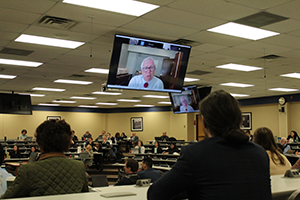
It requires knowledge, judgment, and, at times, courage.
And in a legal profession built on advocacy, it may be one of the most important tools students will carry forward.